The 2026 Discord Analytics Guide (And the Math of Reading at Scale)
Article
Most live-service game studios run their Discord on a stack of tools they assembled gradually: native server Insights for member counts, a moderation bot for filtering, an analytics bot for chart screenshots in producer meetings, the audit log for incidents, and a community manager reading the server every morning. It works fine until it doesn't, and the moment it stops working is rarely loud. The 100,000-message month sneaks up, the CM keeps writing weekly summaries that feel accurate, and the gap between what the community is actually saying and what the studio thinks it's saying widens quietly.
This is the comprehensive 2026 reference for the Discord analytics surfaces available to a game studio today, what each one actually measures, and the message-volume thresholds at which each one stops being a complete answer.
What "Discord analytics" actually refers to in 2026
Six distinct surfaces, often confused for each other:
1. Discord native server Insights
Available in Server Settings → Insights for servers with Community Mode enabled (50+ members and the verification floor). What it shows:
Total messages, total visits, total members (with 7- / 30-day trends).
New members joined per period.
Communicators (members who posted in the period) and Visitors (members who opened the server).
Per-channel message and visitor counts.
Member retention curve (day-1, day-7, day-30 retention of new joiners).
Most-used invites and invite sources.
What it doesn't show:
No message content or intent. It counts messages; it doesn't read them.
No sentiment. A 50% drop in praise is invisible if total message count is steady.
No cohort analysis. Members are members; veterans and new joiners aren't separable on any metric except join date.
No topic detection. What people are talking about is not a dimension Insights exposes.
Limited history. Effectively 30 days for most surfaces; longer trends require export.
No multilingual breakdown. A non-English sub-community looks identical to an English one in the numbers.
Insights is the floor: free, always-on, useful for "are we growing?" and "is this channel busy?" — the two questions Discord designed it for. Past that, it's not analytics in the sense most studios mean the word.
2. Discord audit log
Covered in full in the 2026 Discord audit logs guide. Short version: a complete record of administrative events (bans, kicks, role changes, AutoMod actions, channel edits). Not message content, not patterns, not sentiment. Useful for incident reconstruction and moderator accountability, not for community health.
3. Moderation-bot dashboards
Carl-bot, MEE6, Dyno, Sapphire, Arcane. Each exposes its own analytics surface that wraps around moderation events: warnings issued, AutoMod hits, raid blocks, message deletes, mute counts. Useful for moderator workload management. Not a community-health dataset.
4. Analytics-bot dashboards
Statbot, Discord Tracker, ServerStats, similar. These read Discord's API for member counts, voice-channel time, message-rate-by-channel, and assemble dashboards with charts. Most useful surfaces:
Hourly / daily / weekly message volume by channel.
Active-member counts over time.
Voice-channel usage stats.
New-member joins by source.
What they share with native Insights: they count, they don't read. A spike in messages tells you something happened; it doesn't tell you what.
5. Custom in-house pipelines
Some studios pipe Discord activity through their own data warehouse — webhook the relevant channels into Snowflake or BigQuery, run dashboards in Looker or Metabase. Where in-house pipelines stop:
Message classification is the hard part. Counting messages is trivial; deciding which is a complaint and which is praise is a model problem, not a SQL problem. Most in-house pipelines stall here.
Multilingual coverage costs. Building a sentiment/intent model that handles English, German, Russian, Spanish, Portuguese, and Korean — at a quality your producer trusts — is months of work.
The maintenance never ends. Discord's APIs, message shapes, and community vocabulary all shift; an in-house classifier is a permanent project.
A custom pipeline is the right call for very large publishers with dedicated data teams (Activision, Riot, Tencent). For a 20–200-person studio it's almost always more expensive in engineering hours than buying a layer that already does the work.
6. Community-intelligence platforms
Tools designed to read every message in a Discord server, classify it, build cohorts, surface patterns, and answer questions in plain English. Accord sits here. The category is small and gaming-specific by design — generic social listening tools (Brandwatch, Sprout, Talkwalker) don't handle Discord-shaped data well (multilingual, threaded, reply-chained, emoji-modified) and aren't built for the questions a game-studio CM asks.
The math of when each surface stops being enough
The breakpoint isn't a hard cliff. It's a slope from "this is fine" to "this is missing things" to "we're guessing." Three rough volume zones:
Under ~20,000 messages/month — small community
Native Insights + a moderation bot + a CM reading the server covers the job. The CM can actually read most of the chat in a workday. A weekly summary is accurate because it's been read top to bottom. The audit log catches incidents. The producer's "what are players saying about X?" question gets a good answer in minutes because the CM's head holds it.
At this scale, adding a community-intelligence layer is over-tooling.
20,000–100,000 messages/month — growing community
The slope. The CM is now sampling: choosing channels, skipping windows, prioritising forum posts over chat. Native Insights still works for "are we growing?" The audit log is still complete. But the picture in the CM's head starts to drift from the picture in the dataset.
Specific symptoms in this zone:
Producer-questions take longer to answer with confidence. The CM hedges more.
The weekly summary starts citing the same handful of vocal members regularly. Cohort coverage is narrowing.
Non-English sub-communities are not in the summary unless they explode.
A subtle complaint-ratio shift over two weeks goes unflagged because no surface visualises it.
This is where most live-service Discords sit through the first year of a successful launch. It's also where studios first feel the gap without yet being able to name it.
100,000+ messages/month — live-service at scale
Past 100k/month, in-house manual reading is mathematically incomplete regardless of CM quality. A community manager reading at sustained pace covers 5,000–8,000 messages of meaningful skim per workday. At 100k/month and ~200 working days/year, one FTE covers roughly 1.0–1.6M messages of effective coverage — more than the volume, but only if the CM does nothing else.
Specific patterns that become invisible in this zone without classification:
Slow-burn sentiment shifts (the kind that predict D14 retention drops one to three weeks ahead).
Cohort drift — veterans going quiet vs. vocal new accounts.
Non-English sub-community sentiment.
Cross-channel themes that travel from
#bug-reportsinto#generalinto a forum complaint thread.Counter-narratives sitting in chat channels while a loud forum post takes the attention.
We covered the broader version of this in the in-house community team post. The summary: not a CM-quality problem, a hours-in-the-day problem.
1M+ messages/month — the live-service-at-peak zone
Some live-service game Discords run north of a million messages per month at peak. There is no version of "the CM reads the server" that works at that volume. There is no version of "we pipe everything to Snowflake and figure it out later" that's faster than the cadence a live-service team needs.
At this scale, every analytics surface above except community-intelligence-grade classification is a partial answer at best. Native Insights tells you the server is big. Audit logs tell you moderators are busy. Statbot tells you the message-rate chart is up. None of them tells you whether the new monetisation patch is landing.
What community intelligence adds (beyond all of the above)
A complete read of a live-service Discord pairs the surfaces above with five specific capabilities native Discord analytics never offer:
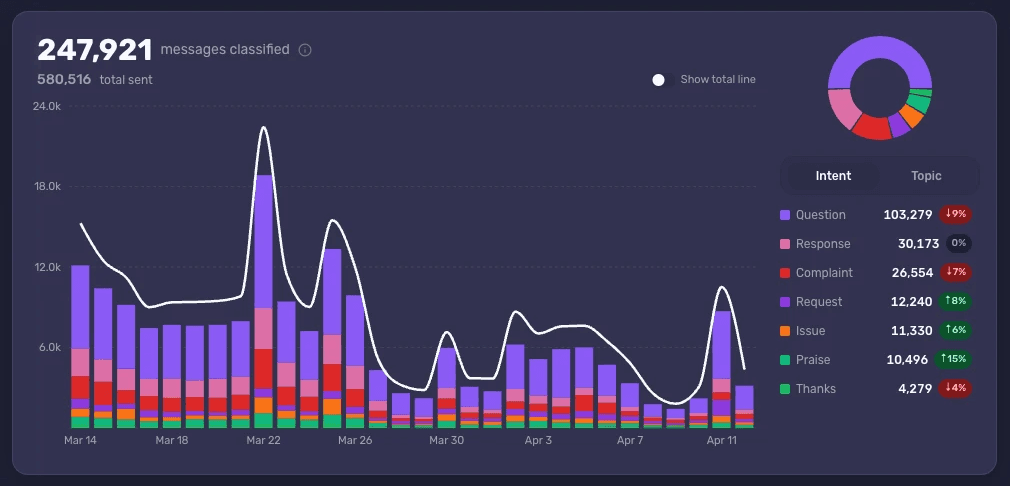
Intent classification on every message — Complaint, Request, Issue, Praise, Question, Thanks, Response — across every channel, in every language the community speaks.
Cohort analysis by ratio, not just volume — so vocal new accounts don't outweigh quiet veteran disengagement. (Lapsed, Most Active, Most Negative-by-Ratio, role-scoped, custom segments.)
Topic and subtopic detection — themes that emerge week-over-week, deduplicated across channels, with sparkcharts and percent-change indicators.
Counter-narrative surfacing — when a complaint is loud in a forum but the chat-channel response disagrees, both sides are visible. This is exactly the forum echo-chamber trap other surfaces miss.
Plain-English querying — "are players upset about the new boss?" returns a chart plus a summary in under a minute, sourced to the underlying messages.
Native Discord Insights answers questions about the server. Community intelligence answers questions about the community. They are different datasets and they are not interchangeable.
A cheap diagnostic
Pick a feedback question your producer asked last week. Try to answer it right now with confidence — sourced, quote-backed, cohort-aware. If it takes more than five minutes using the surfaces you have today, you've outgrown them. That's usually the moment to add an intelligence layer rather than add another dashboard, another bot, or another CM.
The wrong question is "do we have analytics?" — every Discord-running studio does, in some form. The right question is "can we answer questions about our community in the time the team has?" That answer changes with message volume, and most studios don't notice until the answer has been "no" for months.
See what Accord surfaces in your Discord community — book a demo.