Why Your In-House Community Team Is Missing Stuff in Your Discord
Article
A community manager at a mid-sized live-service studio runs a Discord that's doing 80,000 messages a week. She's good. She's been with the studio two years. She reads the server every morning, drafts a weekend summary every Monday, and tells the product team last week's monetization change is landing fine — she hasn't seen a wave of complaints.
The producer ships the next change anyway. D14 retention drops two points. The wave shows up in the right place, a week after the change shipped, in three channels she doesn't follow daily and on a forum thread tagged in Portuguese.
She wasn't wrong. She also couldn't have been right. Past a certain Discord message volume, in-house reading isn't a community-team-quality problem. It's a math problem.
The volume past which "read the server" stops working
The threshold isn't sharp, but it's real. Across the live-service Discords we work with, three rough breakpoints show up consistently:
Up to about 20,000 messages/month — a sharp CM with discipline can actually read most of it. Skim chat, read every forum post, scan reactions, write a clean weekly summary.
50,000/month — selective reading. You're choosing channels and skipping windows. The summary still feels accurate, but you're sampling, not reading.
100,000/month — you're guessing on aggregate questions. "How does the community feel about X?" gets answered from impressions, not the dataset.
250,000+/month — guessing without realizing it. The CM's confidence stays high; the accuracy doesn't.
1M+/month — the largest live-service game Discords sit here. No version of "the community manager just reads the server" is possible. Teams at this scale don't pretend otherwise.
Most growing live-service Discords cross 100,000 messages a month within the first year of a successful launch. The day-one staffing model — one CM, maybe two — doesn't scale with the community it's reading.
What in-house reading systematically misses
Even at sub-threshold scale, manual reading has structural failure modes. The same ones show up at every studio:
Counter-narratives in chat channels. Forum posts get read because they look like signal. The thirty messages in #general disagreeing with the loud forum post don't. We wrote a full piece on this — the Discord forums echo chamber — and it generalizes: the structured-feedback channel gets the attention, the unstructured one carries the missing half of the argument.
Slow-burn pattern shifts. A 12% week-over-week rise in the complaint-to-praise ratio looks like nothing in any individual day. It's only visible aggregated and trended, and aggregating manually is the work nobody has time for. The shift is real and consequential; it's just invisible to scrolling.
Cohort-level signals. When a vocal new account complains loudly about monetization, every CM notices. When ten long-tenured veterans go quiet over the same week, nobody does. The two are different signals about different parts of the community, and the one that matters more for retention is the one no human reads, because non-events don't generate attention.
Non-English conversation. Most community teams have one English-fluent CM and the rest of the world is invisible. EVE Online runs in five languages on any given day. Hearts of Iron 4. Albion Online. War Robots. The fact that the German-language sub-community quietly turned on a feature six weeks ago doesn't make the English-language report.
Reply-chain context. A "yeah this" reply on a forum post is decisive. The same reply read on its own is meaningless. Reading without resolving the reply graph loses half the agreement signal in the server — the half that shows whether the loud minority is alone or backed up.
Selective-reading bias compounds with fatigue. Hour two of scrolling is a different cognitive task from hour one. By Friday afternoon a CM is reading for outliers, not patterns. The patterns are still there.
None of these is fixed by "having a more dedicated CM." They're fixed by reading the dataset differently — which is a tooling problem, not a team-size problem.
QA reads bugs. CMs read vibes. Nobody reads the patterns.
Most studios think they have community intelligence covered because two different teams are already reading the Discord.
The QA team runs a bug-report pipeline. They watch the #bug-reports forum channel, triage tickets, file Jira, ship fixes. They're disciplined about it. They are also, by design, reading only one kind of message — the ones that look like bugs.
The community team reads vibes. They follow #general, react to the loud thing, respond to DMs, and write a weekly digest for product. They cover surface-area QA doesn't.
Both of those are real jobs. Neither of them does the third thing: read every message in the server, classify it by intent, surface aggregate patterns by cohort, and answer questions about trends in a few minutes. That's a different shape of work — closer to data analysis than to community work — and "add a third person" doesn't solve it. You can't read 100,000 messages a month for patterns even if you stare at the screen all eight hours.
Bias modes, even before fatigue
Stack-rank the human biases that show up in manual community reading and four of them have nothing to do with how hard the CM is working:
Recency bias. Today's loud thing dominates the weekly summary, regardless of whether it's the week's most important signal.
Confirmation bias. The product team asked about monetization on Monday, so the CM's reading lens this week is monetization. Last week's veteran-retention thread fades from priority because nobody's asking about it.
Visibility bias. CMs read the channels they're already in. Discord channel permissions and personal habit determine what's visible, not what matters.
Anchor bias. The first three voices in any thread frame the discussion. Whatever loud post lands first sets the lens through which the rest of the replies are read.
None of these get better with more experience or more discipline. They're structural to how human attention works on chat surfaces. They're also exactly what classification at scale removes.
The math of "you can't read it all"
A community manager reading at a sustained pace can cover maybe 5,000–8,000 messages of meaningful skim in a workday — and that's a workday spent only reading, with no responses, no product meetings, no Reddit, no LinkedIn, no demo prep. Two hundred working days a year, that's 1.0–1.6 million messages of effective coverage, optimistically.
That's one full-time person. Loaded cost in the US is $90,000–$130,000 a year. In Europe, where most live-service studios are, the range is lower but not by much. And what you get is one English-speaking lens on the server, with all six bias modes above intact, doing work nobody can verify because nobody else has time to read the dataset.
The math of doing this in-house gets worse, not better, as the community grows.
What "good" looks like — and the cheap test for whether you're there
A community intelligence layer that actually covers a live-service Discord does five specific things no manual reader does at scale:
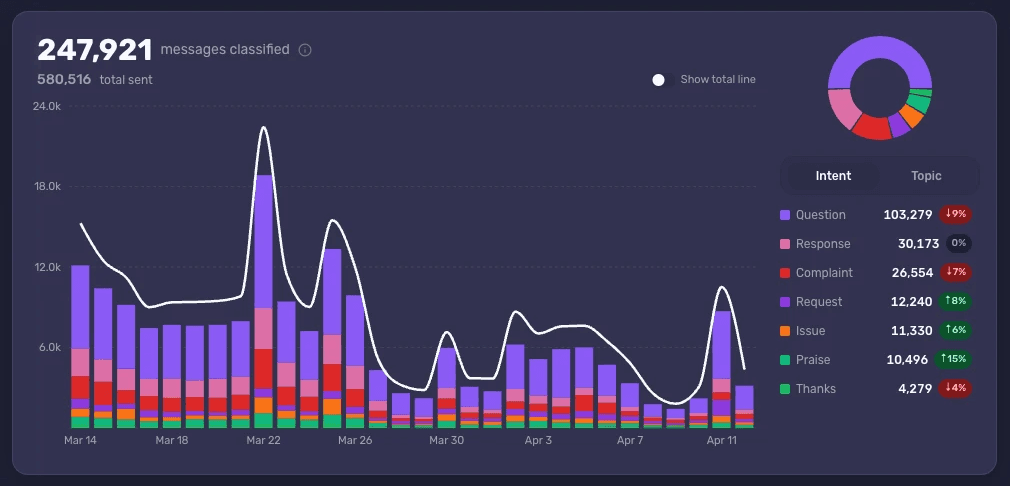
Classifies every message by Topic, Intent (Complaint, Request, Issue, Praise, Question, Thanks, Response), Author, and Cohort — across every channel, in every language the community uses.
Surfaces aggregate pattern shifts week-over-week and update-over-update, with sparkcharts visible at a glance.
Builds cohorts by ratio, not volume — so the loud minority and the quiet majority are visible as distinct populations.
Resolves reply and thread context — agreement and disagreement signals stay attached to the message they refer to.
Lets you query the server in plain English in under a minute — "are players upset about X?" comes back with a chart and a summary, not a five-hour scroll.
The cheap belief-check: pick a feedback question your producer asked you about last week. Try to answer it right now with confidence — sourced, quote-backed, cohort-aware. If it takes more than five minutes, the community intelligence isn't there yet, regardless of how good the team reading the server is.
Gregory Castle, Growth Community Manager at Spark Universe (the team behind Essential Mod, 700k-strong), described the before-and-after directly:
My full-time job was to just read the Discord server — and I still wasn't able to give them a solid answer. Now I can run a report against any question I have and get feedback from the community immediately.
That's the gap. It's not a community-team-quality gap. It's the gap between a smart human reading what they can, and a layer that's read the whole thing on their behalf.
The honest version
In-house community work is not the problem. Asking it to do community intelligence at scale is. The job a great CM does — relationships, judgment, narrative, escalation — does not get replaced by tooling, and shouldn't. What tooling replaces is the part of the job that's mathematically impossible: reading everything, remembering everything, aggregating everything, with no bias.
If your Discord clears 50,000 messages a month and your community team is the only thing reading it, you're missing things you'd want to know. That's not a hypothetical. That's the message volume past which the math stops working.
See what Accord surfaces in your Discord community — book a demo.