Case Study
How Slitherine prioritises feedback for Broken Arrow with Accord

Full Transcript
I'm Marco Minoli, I'm director of publishing at Slitherine. I've been at the company for close to 20 years now, so I've got a history of strategic gaming. The company is now 26 years old. We now have over 250 games on Steam.
Steel Balalaika was an interesting one, because they were looking for a publisher to help them fund the development of the game and also understand a bit more about the market and what was right and wrong for the game, and so on. But almost immediately we saw that there was a different type of potential on that game — because as soon as we announced it, really, players started being very, very excited about it, and somehow supportive of what we want from the game.
So it's been a very community-driven process getting to publish the game. And it's an interesting team because it's their first game, but they are true fans of the genre. They have been playing and making these games as modders forever.
We ran a playtest a few months before release, and we had 200,000 people playing the game. This is still, after a year, one of the top 10 most played RTS — so it's up there with the big, big guys.
So we had to learn a lot in the process, because we're coming from a very indie approach. Because of the sheer number of players, you have, first of all, a lot of different views, and it's very hard to understand and filter what are the important views, what are just the very vocal, pessimistic views, and so on.
On the other hand, we had a cultural issue, where basically we were used to having the vast majority of players from sort of the Western world. With Broken Arrow, we encountered a very split community — so you have about 20-25% of the players from China, 20-25% of the players from Russia, and then rest of the world. So you've got this polarisation of culture within the communities, so that's where you need a lot more help to sort of gauge what's happening and understand where to go, really.
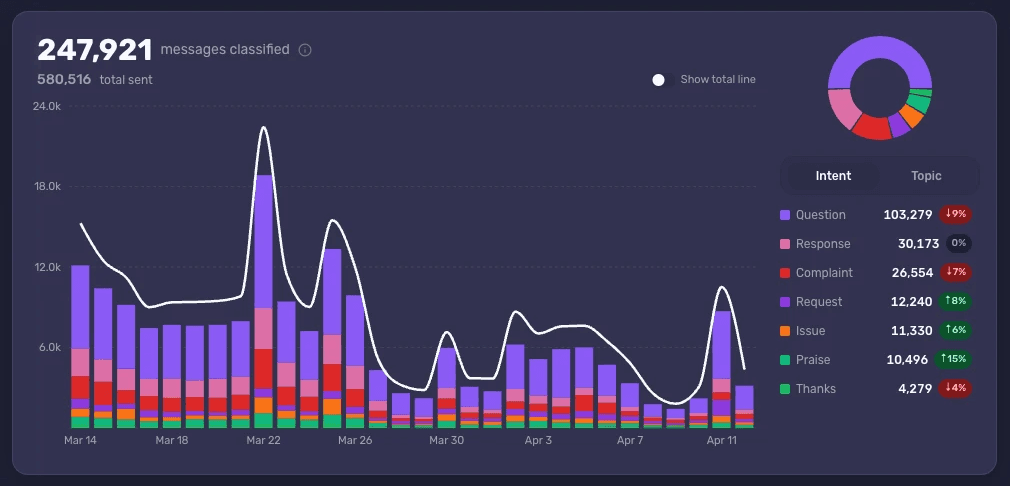
Initially, the goal was to filter what was important and what was just noise. We were receiving a lot of reviews, and because there were so many of them, we couldn't understand what was the priority for the team to address. So with Accord, the first thing we did was just like: let's filter everything, understand what are the big topics.
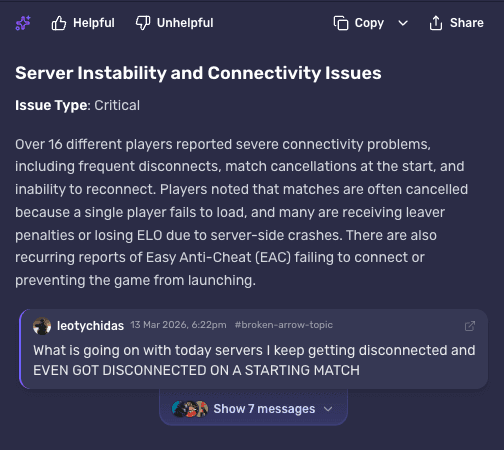
Now, the big topics we could prioritise. Some of the big topics you can easily fix; some of them are long-term fixes. So we went to, first of all, address whatever we could fix easily. And then you fix something — so for instance, cheating was a big thing. We fixed cheating in about two or three months. After fixing cheating, then other things came up, like balance, or content patches, or other requests that are just very specific.
So you then create your roadmap based on customer feedback. And how we managed to sort of react to things is largely thanks to the automation of Accord, that allows us to run constant reports and make sure that we identify very quickly what are the new trends in the world of the community.
With Steel Balalaika, the developers of Broken Arrow, it's a very collaborative effort. We keep asking each other what we should do, and we come up with ideas. If you ask 10 people or 100 people within the community, you'll have 10 or 100 different answers. So we use the tool to have discussions, and then we address things based on a common view.
Discord has the ability to really put people together in a way that no other channel or platform can. Other places like Reddit or the Steam discussion boards will have opinions and views from players that are more reactive than proactive.
There are different types of problems. On one hand, you have the problem of the day. But then you have the recurring issues or requests, and over time you're able to understand what is a sticky request, and what is just a thing that just disappears because it was just like a very vocal minority. And I think there's a big help in using Accord over a long stretch of time, because it helps you understand what stays as a problem to be resolved.
We do weekly queries to understand specific things, but then we have a bi-weekly standard query that we use to see what sticky topics are. So when we release a DLC, or a patch, or an update, or a balance patch, or whatever, we then focus on querying the system maybe two or three times a week. Whilst this ongoing bi-weekly query, we keep doing it in the background. And I have to say that that's the beauty of it in a way — because you can really ask almost like anything you want.
We now have a consistent set of reports that we can compare with each other — so it's like, now, what we've asked three months ago is still comparable with what we've asked now.
With the rise of AI and the idea that anything can be analysed, I think we still need to care about what people want. And I think systems like Accord are actually helping us, not only sort of come up with numbers and figures, but with solutions — which is what we need.
Expand

Background
Marco Minoli is director of publishing at Slitherine, and he's been there nearly twenty years. The company is twenty-six. Between them, they have over 250 strategy games on Steam — most of them deeply genre, niche by design, answerable to communities Slitherine's team knows well.
Broken Arrow was a different proposition. Developed by Steel Balalaika — their first commercial game, but a team of lifelong genre fans and modders — Broken Arrow drew 200,000 players in a single playtest months before release. A year in, it's still one of the top 10 most-played real-time strategy games on Steam. That kind of scale forces a publisher to learn new workflows.
The Challenge
Two problems hit Slitherine at once.
The first was volume. With that many players, the team was buried in reviews and reactions, with no clean way to tell signal from noise.
"We were receiving a lot of reviews, and because there were so many of them, we couldn't understand what was the priority for the team to address."
The second was cultural. Slitherine's previous workflows were built around an assumption that broke immediately:
"We were used to having the vast majority of players from sort of the Western world. With Broken Arrow, we encountered a very split community — so you have about 20-25% of the players from China, 20-25% from Russia, and then rest of the world."
A community polarised across three regions doesn't react like a Western-default community. Vocal minorities sit in different time zones. The same in-game decision can read very differently in three places at once. And the team's instinct for what mattered — built up across two decades of indie strategy publishing — was suddenly less useful than it used to be.

The Solution
The first move with Accord was simple: filter everything, find the big topics.
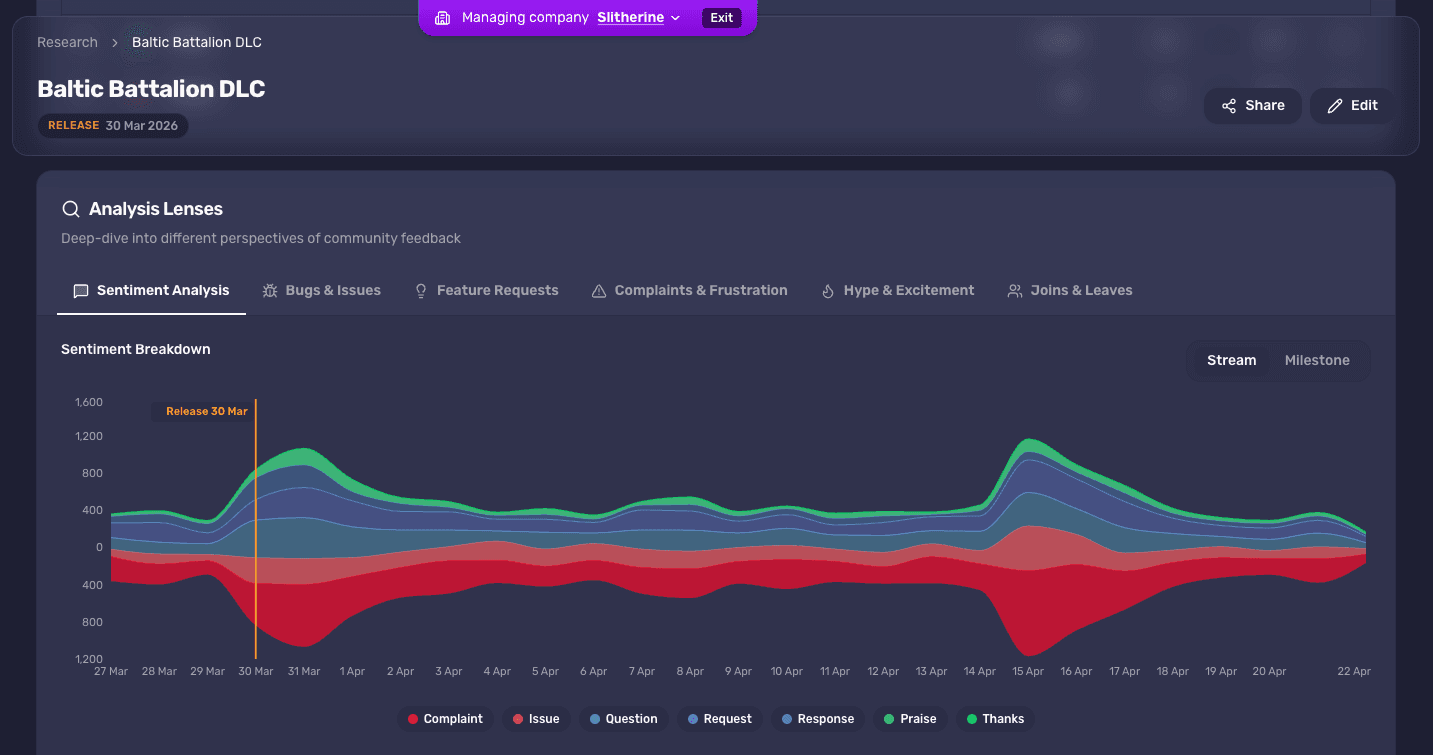
Once they had a ranked view of what the community was actually surfacing, the team could split it into the work they could do quickly and the work that needed time. They went after the easy wins first.
"Cheating was a big thing. So we fixed cheating in about two or three months. After fixing cheating, then other things came up — like balance, or content patches, or other requests that are just very specific."
The roadmap stopped being a publisher-led document and started being a community-fed one. A standing bi-weekly query kept the sticky topics visible. Weekly queries handled specific questions. Around releases — DLC drops, patches, balance changes — the team queried Accord two or three times a week.
The consistency mattered more than any single query.
"We now have a consistent set of reports that we can compare with each other — what we've asked three months ago is still comparable with what we've asked now."
That comparability is what turns Discord noise into a long-running dataset. Sticky problems stay visible across months. Vocal minorities show themselves over time by not showing up twice.
The Outcome
The work between Slitherine and Steel Balalaika has become genuinely collaborative — both sides looking at the same Accord reports, having the same arguments off the same evidence.
"If you ask 10 people or 100 people within the community, you'll have 10 or 100 different answers. So we use the tool to have discussions, and then we address things based on a common view."
That last part is the shift. The tool isn't just measuring sentiment; it's giving two teams a shared substrate for decisions — one that holds up against a community far larger and more fragmented than either of them had worked with before.
"With the rise of AI and the idea that anything can be analysed, I think we still need to care about what people want. And I think systems like Accord are actually helping us — not only come up with numbers and figures, but with solutions, which is what we need."
— Marco Minoli, Director of Publishing, Slitherine