The 2026 Discord Server Rules Guide for Game Communities
Article
A Discord server's rulebook is the easiest thing on the platform to copy from another server and the hardest thing to make actually load-bearing. For a game studio's community Discord, the rules do three jobs at once: they set legal/safety expectations, they communicate culture, and they give moderators something to point at. The ones that work share a structure, an ordering, and a tone. The ones that don't are usually copy-pasted, contradictory, and out of date — and worst of all, give the studio false confidence that "we have rules, so we have a community."
This is the comprehensive 2026 reference for what to put in a game-studio Discord rulebook, how to structure it for actual use, and the boundary between rules (what you enforce) and culture (what you have to read to know).
What every game-community Discord rulebook should cover
A working game-Discord rulebook in 2026 has roughly nine sections. Each does a specific job; none can be skipped if you want consistent moderation across a team of mods.
1. Code of conduct — the universal floor
The non-negotiable basics, written so they apply across cultures and languages your community actually uses. Standard inclusions:
No harassment, hate speech, or discriminatory content (race, religion, gender, sexuality, nationality, disability).
No threats, doxxing, or sharing of private information.
No NSFW or graphic content in non-NSFW channels (or anywhere if you don't run NSFW channels — most game studios shouldn't).
No illegal content. No promotion of illegal activity.
No targeted attacks on members, staff, content creators, or competitors.
This section is short, blunt, and not negotiable per-case. It's the floor you build everything else on top of.
2. Spam, advertising, and self-promotion
The rules that take up most of a moderator's time. Be explicit:
No unsolicited DMs to promote anything (Discord communities, services, products, NFTs, OnlyFans, "growth services" — name the recurring ones in your community).
No advertising other Discord servers without staff permission.
Self-promotion (streams, YouTube, fan content) goes in a dedicated channel — name the channel and the rules for it (frequency cap, no link-only posts, etc.).
Distinguish memes/jokes from spam. A server-specific definition of "spam" beats a generic one.
3. Cheating, exploits, and account integrity
Game-specific and the section that varies most by title:
No discussion of cheats, hacks, exploits, or unauthorised third-party tools (with an explicit naming of any that recur).
No account selling, trading, or sharing.
No real-money trading (RMT) — name the in-game items/currencies if applicable.
No begging, scamming, or social engineering of other players or staff.
For free-to-play and live-service titles, this section often runs the longest because the exploit surface is large.
4. Spoilers, leaks, and datamines
Massive for narrative games, live-service titles with sequential content drops, and any game with an active datamining community.
Define the spoiler window (e.g., 48 hours after a major patch; until the season's narrative arc concludes).
Datamined content rules — many studios disallow leaked content entirely. Be explicit, name the policy.
How to use the
||spoiler||markdown for late-period spoilers — link to the 2026 Discord Formatting Guide if helpful.Dedicated channels for leaks/datamines if you allow them at all.
5. Bug reports and feedback
Some studios put this in the rulebook; some keep it as a separate "how to give feedback" doc. Either way the rule is the same:
Where to report bugs (forum channel, web form, support ticket).
Where not to report bugs (
#general, DMs to staff, replies to announcements).How to format a useful bug report (steps to reproduce, screenshots/clips, build version).
What happens after a report (acknowledgement window, status updates, no individual replies).
Studios that handle this section well save their moderators hours per week.
6. Channel etiquette
Per-channel specifics, kept short:
Language requirements (English-only in
#general, language-specific in regional channels — or no requirement, but make it explicit).Topic boundaries (what
#off-topicis for, what it isn't).Pinging staff rules (
@here,@everyone, and role pings).Voice channel etiquette (no joining empty voice for "AFK" purposes, no music without permission, etc.).
7. Staff, moderators, and conflict resolution
How players interact with the team:
Who staff are (link to a staff list or role tags).
How to escalate (a
#modmailchannel, a ticket bot, a contact email — name one canonical route).What to do if a moderator action feels wrong (don't argue in-channel; appeal through the stated route).
Studio staff vs. community moderators distinction (some communities are heavily volunteer-moderated; players should know which is which).
8. Consequences
The enforcement ladder. Explicit, short, public.
Warning → timeout → temporary ban → permanent ban, typically.
What's appealable, what isn't (e.g., bans for slurs are usually unappealable; bans for argument-spam might be).
Where the appeal goes.
Avoid case-by-case opacity here. A clear ladder is what makes moderators consistent.
9. Disclaimers and platform alignment
The fine print:
Subject to Discord's Community Guidelines and Terms of Service.
Subject to the studio's broader code of conduct or EULA (link).
Rules subject to change; date of last update.
Structuring the rules so they get read
The biggest practical failure of game-community rulebooks is that nobody reads them. Three structural fixes:
Put it in a forum channel, not a wall-of-text channel. A #rules forum with each section as a separate, titled post (Code of Conduct, Cheating & RMT, Spoilers & Leaks, Bug Reports, etc.) is searchable by tag, scannable, and easy to link to specific rules in moderation messages.
Pin the one-page summary. Even if the forum channel is the canonical source, a single-message summary pinned in #welcome or #general reaches the people who'll never click into the rules. Keep it under 200 words.
Date every section. A Last updated: 2026-04-01 line below each section signals current-ness and forces the team to revisit. Stale rules — where the in-game item your RMT rule was about no longer exists — undermine the whole document.
Connect rules to onboarding
The handful of game-community Discords that do get rules right have a specific verification or onboarding step that requires acknowledging the rules before access. The mechanics vary:
A Bloxlink or RoVer verification step (Roblox communities).
A captcha + react-to-this-message + auto-role flow (mainstream pattern).
A specific gate in Discord's native onboarding system (Server Settings → Onboarding, available since 2022).
Whatever you pick, the principle is the same: members don't see the rest of the server until they've passed through the rulebook. That's the difference between "we posted rules" and "every member has been through them."
Why rules don't equal culture
A complete, well-structured rulebook is the floor of community health. It is not the ceiling, and it isn't even most of the building. Rules tell you the boundaries of acceptable behaviour. They tell you nothing about whether the community is actually working — whether veterans are still engaged, whether new players are landing, whether the loud minority is steering perception of the silent majority, whether the patch that just dropped is being received the way the producer hopes.
Three specific blind spots even a perfect ruleset has:
Vibes aren't violations. A community can run inside the rules and still be sliding — bored veterans drifting off, new players quietly bouncing, sentiment around monetisation slowly going sideways. None of that breaks any rule on any page of any rulebook. The audit log stays clean. The Discord still feels wrong.
Enforcement counts ≠ community health. Some of the worst-performing game communities have the busiest moderation logs. Rule-fires are about rule-breakers, not about whether the rest of the community is having a good time. We wrote about this distinction in the Discord moderation bots post — rules and mod bots cover the bottom layer; everything else needs different tools.
A clean rulebook can mask a missing read. Studios that have a tidy #rules forum often assume "community" is sorted because the visible infrastructure is in place. The actual work — reading what your community is saying, in aggregate, with cohort awareness — is a different job that no rulebook ever covers.
What good "beyond the rulebook" looks like
A complete read of a game-studio Discord pairs the rulebook with three additional layers:
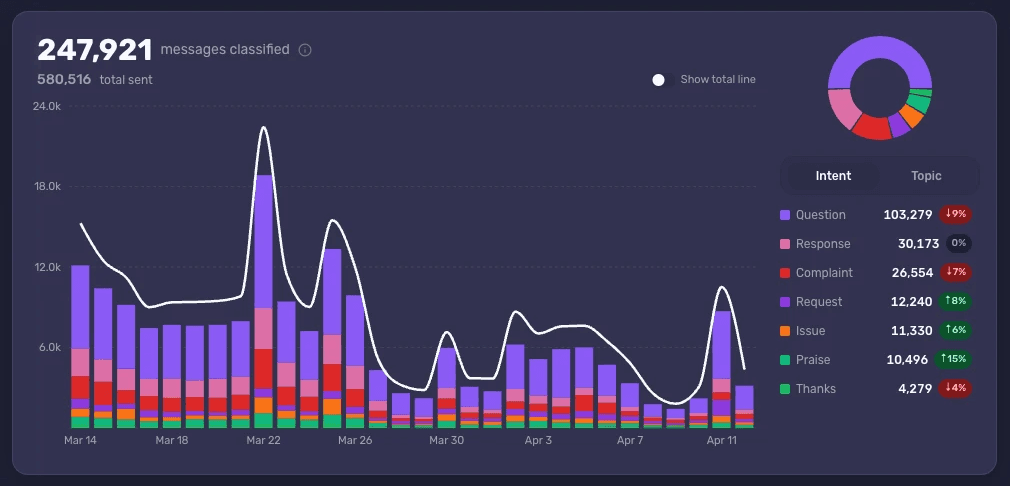
Real-time intent classification of every message (Complaint, Request, Issue, Praise, Question, Thanks, Response) so the texture of the conversation is queryable, not just the rule-violations.
Cohort analysis — Most Positive, Most Negative by ratio, Lapsed, role-scoped segments — so the rulebook-conforming silent majority is visible alongside the loud rulebook-conforming minority.
Cross-channel pattern detection. Patterns that cross from
#bug-reportsinto#generalinto a forum complaint thread are the most important signals; no rulebook captures them, and no single channel-read does either.
The rulebook is necessary. It is not the answer to "how is our community?" It's the answer to "what are the boundaries of acceptable behaviour here?" — and that's a different question.
The honest version
Rules don't make culture. They protect the floor while culture is built on top. The best game-studio Discords have a tidy rulebook and read their community as data — because at any scale past the smallest indie launch, you can't tell whether the culture is working by looking at how often the rules get used.
If you can't answer "what's the actual mood in the server right now, and how has it shifted in the last two weeks?" in under five minutes — having a great rulebook hasn't fixed your community visibility problem. It's only fixed your enforcement problem, which is a different one.
See what Accord surfaces in your Discord community — book a demo.