Discord Moderation Bots Aren't Enough for a Live Game Community
It's 9am Monday at a mid-sized game studio. The overnight mod bot report is on screen: Carl kicked 47 accounts for spam, Dyno deleted 120 messages for slur filtering, and the auto-role assignments ran clean. By every measure the dashboard tracks, the weekend was quiet.
Meanwhile, six consecutive messages from a single high-karma player in the suggestions channel — about monetization changes in the new patch — haven't been surfaced anywhere. Neither has the fact that three of the studio's most-active veterans haven't posted in four days. Neither has the 40% spike in "why bother" sentiment in #general-chat.
Mod bots handle the obvious 10% of moderation. The other 90% is what determines whether your community stays.
What mod bots actually do well
For the record: every active Discord community needs a moderation bot, and the big names each do what they claim.
Carl-bot — reaction roles, logging, automod rules with per-channel overrides, welcome flows.
MEE6 — levelling, moderation, welcome messages, basic automod.
Dyno — custom automod, moderation commands, anti-raid.
Sapphire / Arcane — the newer generation; similar feature sets, slightly better UX.
Native Discord AutoMod — spam, slurs, link filters, mention spam. Free and sufficient for the basics.
What they reliably catch: spam, rate-limit abuse, banned words, raid attempts, link-farm accounts, brand-new accounts spiking into voice channels. They log bans, kicks, mutes, and message deletions in a searchable audit channel. For the 5k-member server running on volunteer moderators, this is the bedrock.
It's also the limit of what they see.
Where mod bots run out of road
A mod bot looks at individual messages in isolation and asks: does this match a rule? That frame is useful for obvious violations and useless for everything else. Four specific failure modes a community manager at a live-service studio sees every week:
Sentiment inversion. "Great new balance patch 🙃" passes every automod filter. So does "Sure, love the monetization update." A mod bot can't read tone; a community that runs on vibes has a lot of tone. The most important complaint in the server this week is usually written as a compliment.
Reply and thread context. "Yeah this" as a standalone message is meaningless. "Yeah this" as a reply to a veteran's 400-word rant about class balance is a signal boost. Mod bots treat the reply the same way they treat random chat. Analysis that strips the reply relationship loses half the agreement signal in the server.
Cohort drift. One new user with a loud complaint is not the same as your top 50 lifetime-value players going quiet. Mod bots react to the loud user. The quiet ones, the ones who matter for retention, are invisible to them because they're not doing anything rule-adjacent.
Pattern change over time. A 12% week-over-week shift in complaint-to-praise ratio across your #feedback channel is the single most important thing that happened this week. A mod bot will never flag it, because nothing broke a rule. Every message was fine; the mix of messages changed.
Each one of these is the kind of thing a studio needs to react to inside 24 hours and won't hear about for a month if mod bots are the only eye on the server.
What moderation actually is at scale
For a 20k+ message/month game community, "moderation" as mod bots define it — removing rule-breakers — is table stakes. The actual job is protecting the signal-to-noise ratio of the community itself: making sure the important feedback, the emerging frustration, the quiet churn risk, and the real questions from new players are findable over the chat-room churn.
That reframes what you watch:
Who's going quiet matters more than who's loud. Lapsed cohorts — active veterans who stopped posting — are a leading indicator for churn.
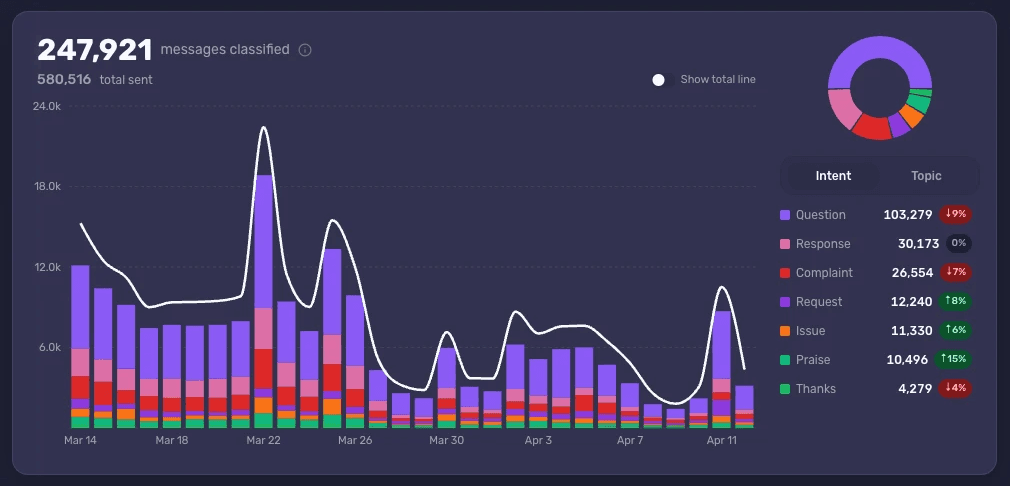
Intent mix — the ratio of Complaints, Requests, Issues, Praise, Questions, Thanks, and Responses — tells you what the community is doing this week, not just how many messages they wrote.
Author status transitions — who's been kicked, who left on their own, who came back after being unbanned — is richer than the raw ban count.
New-user reactions versus veteran reactions to the same patch are almost always different conversations. Treating them as one mass reaction is how studios ship the wrong fix.
None of this is visible in an automod dashboard. All of it is visible in a community that's being read, not just filtered.
The Monday morning that actually worked
A real version of this happened inside Spark Universe's community team. Gregory Castle, Growth Community Manager on the Essential Mod (700k+ community, Minecraft):
Just yesterday, a new user jumped into the server and was complaining left, right, and centre about monetization. For my general reporting, monetization got flagged as a problem. If I'd just looked at my Discord and gone to the team, maybe we would have made an ill-advised change.
What changed the outcome wasn't a better mod bot. It was reading the complaint at a cohort level: the new user was loud, but when Gregory opened the conversation thread, veteran players and other new users were in there disagreeing — "actually we like it this way, it's not pay to win." The single loud voice looked like a problem; the community around it showed it wasn't.
That allowed me to give the opposite feedback to the team: people are actually really happy with the monetization at the moment, despite one or two of the sort of live minority coming in and making waves.
A mod bot would have either ignored the message (no rule broken) or, if the complaint had been phrased more aggressively, deleted it as disrespect — losing the real signal either way.
What to put next to your mod bot
The pairing that works for live-service Discord is conceptually clean: mod bots handle events that break rules, community intelligence handles patterns that change the community. They're not the same job. They don't use the same tools.
What community intelligence adds on top of a mod-bot stack:
Intent classification across every message (Complaint, Request, Issue, Praise, Question, Thanks, Response) so mix shifts are detectable.
Cohort analysis — Most Active, Most Negative by ratio, Lapsed, role-scoped segments — so you can see who's driving a pattern, not just what the pattern is.
Author status tracking across time, with filterable badges for Active, Left, Kicked, Banned, Unbanned, so churn and moderation outcomes sit in the same view.
Topic and subtopic trends with 30-day sparkcharts, so the week's biggest movement in conversation finds you instead of the other way round.
AI summaries on demand for any topic, cohort, or time range, so "what did the server say about the patch this week" is a 30-second query, not a three-day reading job.
Mod bots do moderation in the old sense of the word: enforcing the rules. Community intelligence does moderation in the sense that matters for a live-service game: keeping the community readable, so the team can act on what it's actually telling you.
See what Accord surfaces in your Discord community — book a demo.