The 2026 Discord Formatting Guide (And Why It Breaks Analysis)
Discord formatting is two things at once. For the person typing, it's a few strokes that turn a message into something scannable — bold for a headline, a code block for a patch note, a > quote to call back to what someone said five minutes ago. For anyone trying to read the server after the fact — a community manager on Monday morning, a producer reviewing player sentiment, an analyst pulling last month's complaints — it's a wall of markdown, emoji, reply chains, and mid-thought chunks that makes "what is the community actually saying?" a harder question than it should be.
This guide covers both halves. First, the complete reference: every Discord formatting command in 2026. Then the part nobody else writes about: why those same commands make community analysis a genuinely hard problem, and what it takes to do it properly at the scale of a live-service game.
The 2026 Discord formatting cheat sheet
You type | You get |
|---|---|
| bold |
| italics |
| underlined text |
| strikethrough |
| bold italics |
|
|
| fenced code block (optional language for syntax highlighting) |
| hidden spoiler text, click to reveal |
| single-line block quote |
| everything after this is block-quoted |
| large, medium, small headings |
| small muted subtext below a message |
| bulleted list |
| numbered list |
| masked link (available in announcements, embeds, webhooks) |
| escape with a backslash to show raw characters |
Discord applies markdown client-side, which is why every client — desktop, mobile, the web app — renders the same characters the same way. That's great for writers. It's the start of the problem for analysis.
Text styles and inline formatting
The inline set is small and settled: bold, italic, underline, strikethrough, and inline code. Combine them freely — ***__this is all four__*** is bold, italic, and underlined.
One subtle detail: *single asterisks* and _single underscores_ both render as italics, but underscores inside words don't format (so snake_case_names stays readable, which is deliberate for anyone sharing code or file paths). Use asterisks when you want italics inside a word.
Blocks, quotes, and spoilers
Three-backtick fenced blocks are the right choice for patch notes, logs, or any multi-line output. Adding a language — ```js or ```python — triggers syntax highlighting. Inline backticks are for short references: a command, a file name, a status code.
Block quotes come in two forms. > quotes a single line. >>> quotes every line until the end of the message, which is the one to use when you're responding to a long post. Both are surprisingly readable — one of the cleaner affordances Discord ships.
Spoilers use ||text|| and stay hidden until someone clicks. Use them for lore, plot points, or anything someone asked not to be surprised by. They're also the single most frequently misused format in gaming communities — not every hot take is a spoiler.
Headers, lists, and subtext
Headers landed in 2023 and changed how serious Discord messages look. # Heading is large, ## is medium, ### is small. One per line, at the start of the line.
Lists are standard: - or * for bullets, 1. for numbered. Indent nested items with two spaces.
Subtext arrived in 2024 as -# text — small, muted grey text that sits below a message. It's perfect for a caveat, a timestamp, a "posted on behalf of", or a footnote under an announcement.
Mentions, timestamps, and rich tags
Plain @ mentions resolve inside the client: @username, #channel-name, @role-name, and the two server-wide ones, @everyone and @here. Underlying IDs look like <@123456789> for a user, <#123456789> for a channel, and <@&123456789> for a role.
Timestamps are the most underused feature. <t:1709654400:F> renders the Unix timestamp in the reader's local timezone. The letter at the end picks the format:
t— short time (14:30)T— long time (14:30:00)d— short date (24/02/2024)D— long date (24 February 2024)f— short date/time (24 February 2024 14:30)F— long date/time (Saturday, 24 February 2024 14:30)R— relative time ("in 2 hours", "3 days ago")
Use R in announcements so "patch drops in 4 hours" stays accurate however many timezones away your players live.
Emojis: visual meaning, analytical chaos
Three kinds of emoji live in a Discord message, and every one of them carries meaning that isn't in the text:
Unicode emojis — 🔥 👀 💀 — the cross-platform ones. Context comes from culture: 💀 is almost never about death; 🔥 is almost never about fire.
Custom server emojis —
:pepepoggers:,:serverlogo:, anything a community uploaded. Meaning is specific to that server and often changes over time.Animated emojis — same as custom, with motion. Nitro users can drop them anywhere.
Emojis are the hardest part of formatting for a reader and an analyst alike. A player who writes "great new balance update 🙃" is not paying a compliment. A thumbs-up emoji on a bug report can mean "acknowledged", "me too", or "closed — won't fix". The symbol is doing the work the words aren't, and it's doing it in ways that don't generalise across communities, games, or even channels.
Emoji context probably deserves its own post. For now: any analysis of a gaming Discord that treats emojis as noise — or, worse, strips them — loses the most important half of the signal.
Why Discord formatting is a nightmare for analysis
Imagine opening Monday's Discord with 40,000 new messages and a question from product: "Are players upset about the new monetization model?"
Every formatting choice above gets in the way of answering that. A few of the real problems:
Markdown noise. Raw message text is full of
**,~~,||,`characters. If your pipeline reads**bug**as a different token frombug, sentiment and topic models fall apart immediately. If it strips markdown blindly, a code block full of a player pasting their crash log becomes indistinguishable from narrative complaint.Reply chains. A message that says just "yeah this" is meaningless in isolation and decisive in context. Without resolving the
replied torelationship, half the server's agreement signals vanish.Threads. A thread has its own scoped conversation off a parent channel. Analysis that reads the main channel but ignores threads misses exactly the deep-dive discussions product teams most want to see.
Chunked messages. Players don't write paragraphs. They write "so this happened" / "and then the patch dropped" / "and now damage scaling is broken on mage" — three messages in twelve seconds, one actual thought. If those three get classified independently, you end up with three different topics instead of one complaint about damage scaling.
Language mixing. Communities on EVE Online, Hearts of Iron 4, or Albion Online routinely thread English, German, Russian, Spanish, and Korean in a single channel. Single-language analysis tools miss everything not in English.
Long messages. A 3,000-word wall-of-text manifesto about economy balance deserves very different handling from 3,000 two-word messages. Both are signal; they aren't the same signal.
Junk and short messages.
gg,+1,👀,/join. Real engagement, zero analytical content on their own. They need to count as activity without polluting topic analysis.
Any of these on its own is solvable. All of them, in the same server, in volumes that cross tens of thousands or millions of messages a month, at the speed a live-service team needs answers — that's the actual problem.
How Accord reads formatted Discord

Turning Discord's formatting chaos into clean data is the problem Accord was built to solve, and it's where a lot of engineering time goes. A few of the pieces:
Markdown-aware tokenisation. Accord parses formatting instead of stripping it. A word inside
**bold**stays the same token as the same word plain — the emphasis becomes a feature the model can use, not garbage in the input.Reply and thread resolution. Every message knows its parent, its thread, and its channel. "yeah this" gets scored against the message it's answering, not in isolation. Thread conversations are analysed as their own scoped context.
Message chunking. Close-together messages from the same author about the same subject get grouped as a single conversational unit before classification, so a three-message thought lands as one topic rather than three.
Multilingual classification. Accord handles the languages gaming communities actually use — English, German, Russian, Portuguese, Spanish, Korean, and more — without forcing one locale as the default.
Context-aware emoji handling. Emojis are scored as sentiment and intent modifiers, not stripped.
🙃flips the sentiment of the sentence it lands in.💀in a bug report is a very different signal from💀in a response to a joke.Junk filtering without discarding activity. Short acknowledgements and single emojis count as engagement — they move activity metrics, they don't confuse topic counts.
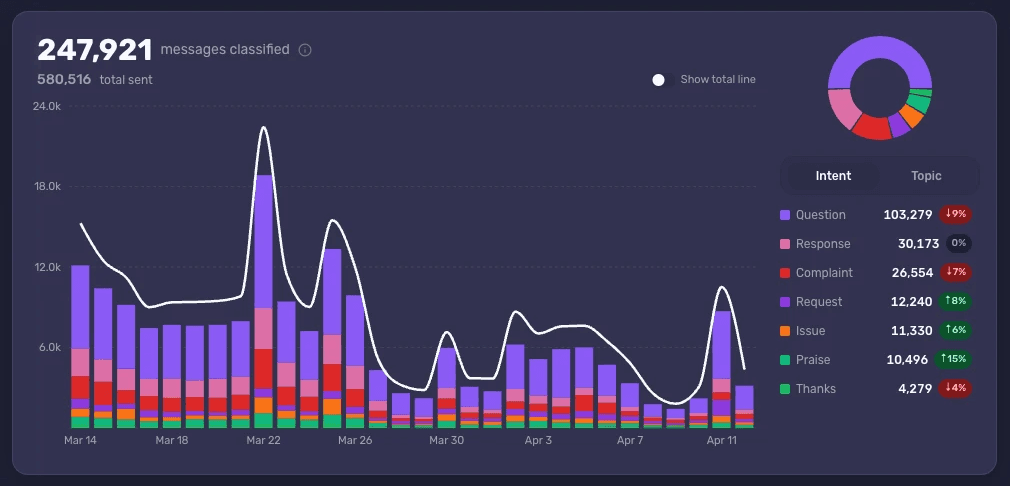
The output isn't a cleaner version of the Discord feed. It's something different: a structured set of Topics, Intents (Complaint, Request, Issue, Praise, Question, Thanks, Response), Authors, and Cohorts you can actually query.
What this saves you
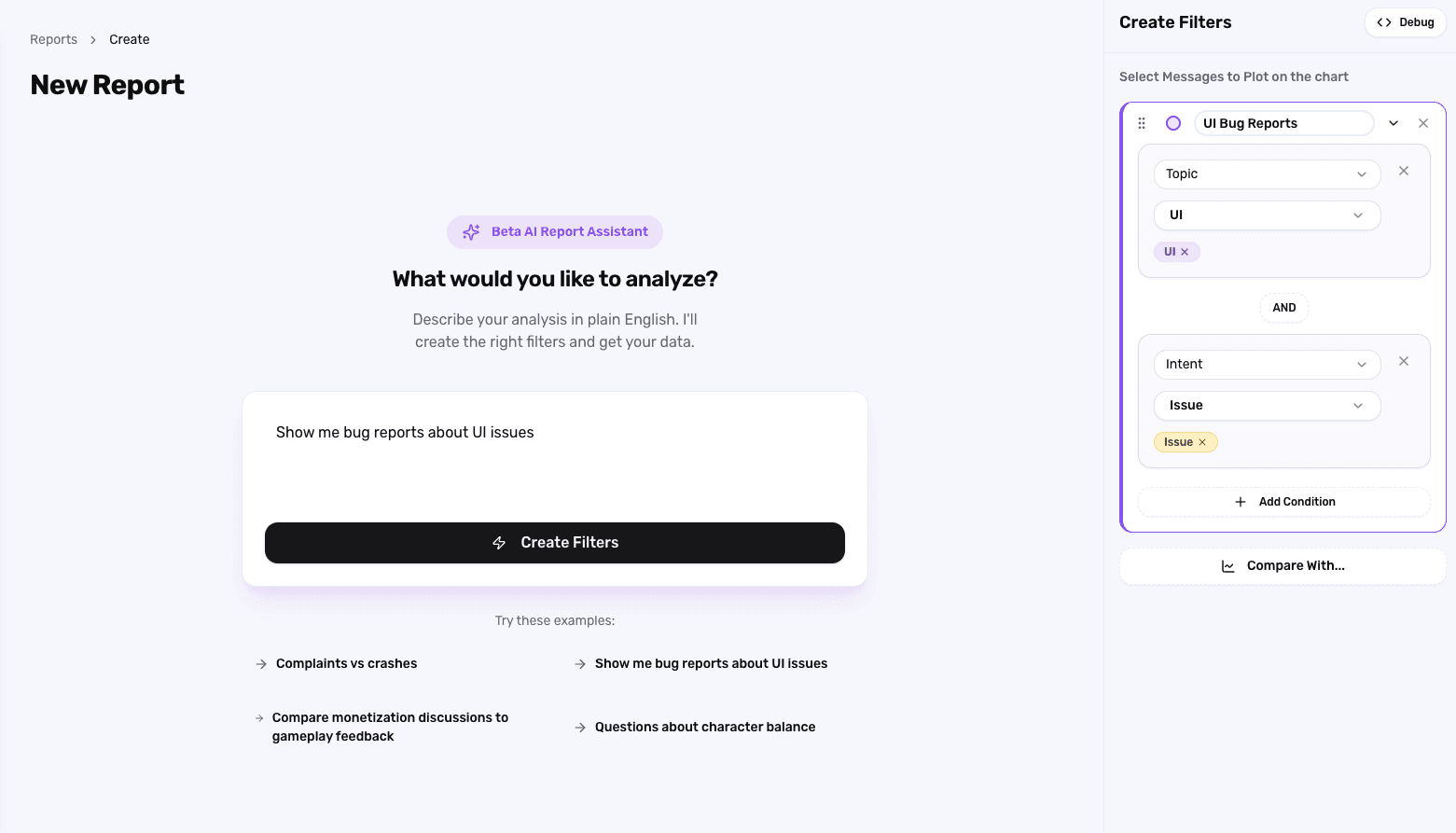
Gregory Castle, Growth Community Manager at Spark Universe (the team behind the 700k-strong Essential Mod community), puts the before-and-after plainly:
My full-time job was to just read the Discord server — and I still wasn't able to give them a solid answer. Now I can run a report against any question I have and get feedback from the community immediately.
The scale varies — Accord's customer servers range from 10k messages a month at indie studios like Savy Soda (Pixel Starships 2) to over a million a month at the largest live-service game communities. The shape of the saving doesn't: analysis that used to mean a full-time role or a week-long forum post becomes a query a community manager runs in the minutes between stand-ups. Gregory again:
Accord is now one of the four things I click on when I open my computer in the morning.
For live-service teams, the win is speed plus confidence. Gregory's team almost shipped a monetization change based on a single vocal new user — until a cohort analysis showed veteran players and other new users explicitly saying the current model was fine. Reading Discord at a cohort level, not a message level, is what kept them from building the wrong thing.
See what Accord surfaces in your Discord community — book a demo.