When loud Robux complaints don't mean your community wants cheaper prices
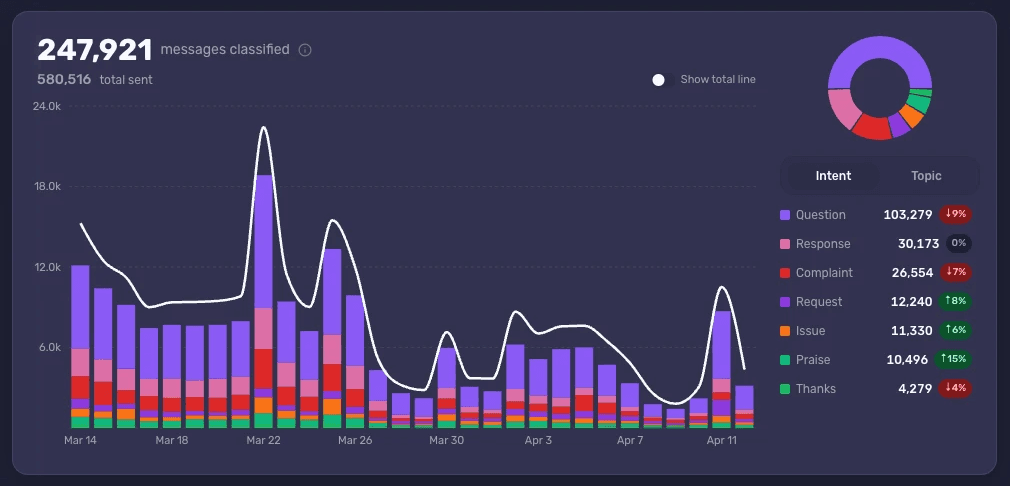
Saturday morning. A new account joins your Discord, posts five times in an hour about Robux being too expensive, and three other new members pile on. By Monday your producer is asking whether to drop the price of a key developer product before the weekend's data is even cleaned up. This pattern shows up on almost every Roblox community Discord with more than 50k members, and the wrong call costs you real revenue.
The way to navigate it isn't gut-feel. It's a cohort check that takes three minutes, and it almost always changes what you tell the producer.
The pattern: a Saturday wave of Robux complaints
It looks roughly the same every time. A small group of accounts — usually new, often created in the last week — concentrate complaint messages about pricing into a tight window. The complaint sounds urgent because it's loud, recent, and unanimous within that group. The first instinct, if you're a CM under time pressure, is to amplify the signal: "monetization sentiment is shifting, we should consider a price change."
Sometimes that instinct is right. Most of the time it's measuring a small, specific group instead of the community.
Why volume is the wrong signal
The mistake is using raw message volume as the measurement. Five accounts posting twenty messages each looks identical to twenty accounts posting five messages each, on a count chart. They are very different signals.
What matters is the ratio of complaint messages against the spread of users producing them. When a complaint is real, it shows up across many distinct authors with diverse posting histories. When a complaint is a vocal minority, it shows up in a tight cluster of accounts whose own posting history is mostly criticism.
This is what cohorts are for.
The two cohorts that actually matter
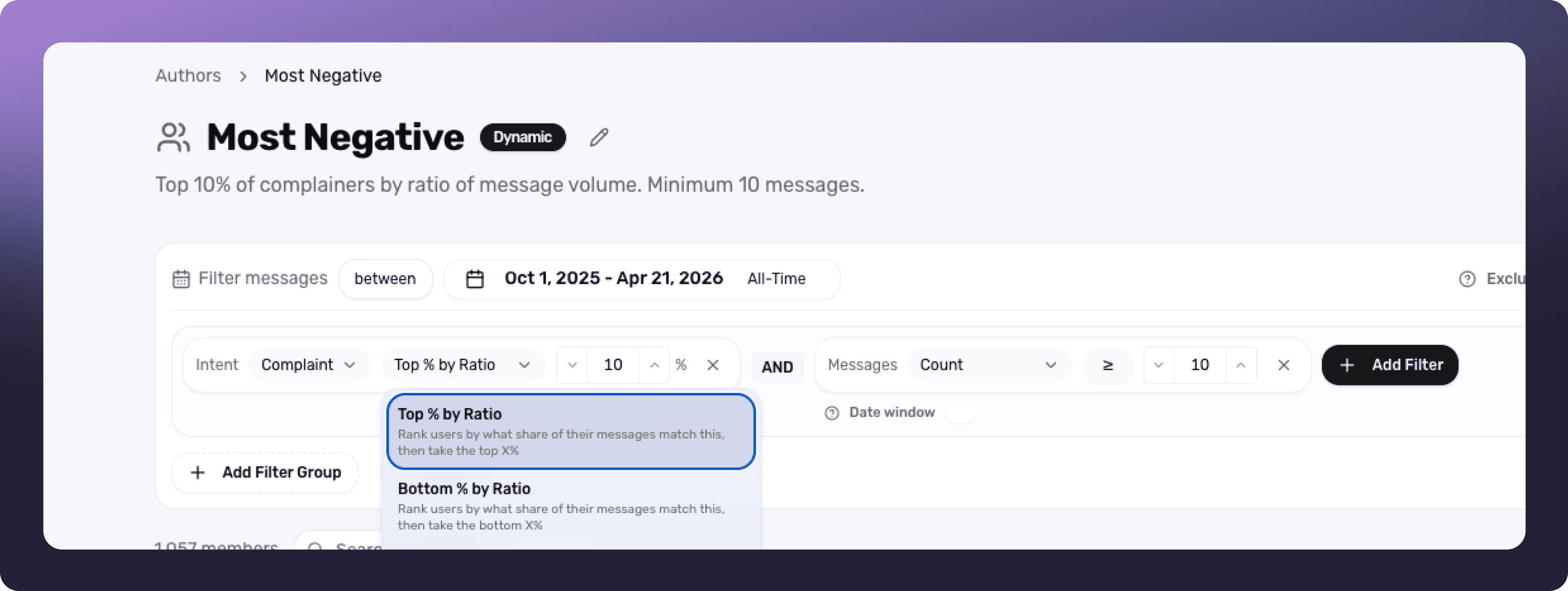
Pull two cohorts on the Robux Topic in Accord:
Squeaky-wheel cohort. Top percentage of users by ratio of Complaint-classified messages. This catches accounts whose entire footprint in your server is criticism, regardless of how much they post overall.
Active veteran cohort. Long-tenured, high-volume contributors who post across many Topics, not just monetization. Filterable by Discord role if your server has a Veterans tag.
Now look at the Robux pricing conversation through both lenses. Three patterns are common:
Squeaky-wheel cohort loud, veteran cohort silent. This is the false-alarm pattern. The price isn't the problem; the loud accounts are. Your studio shouldn't change pricing on this signal alone.
Squeaky-wheel cohort loud, veteran cohort actively defending current pricing. This is the cohort flip we hear about most often. Veterans tell product the opposite of what the loud accounts are saying. One growth community manager described catching exactly this pattern and using it to avoid an ill-advised price change.
Both cohorts complaining, with overlap on specific items rather than pricing in general. This is the real signal — and it almost never sounds like "Robux is too expensive." It sounds like "this specific developer product is overpriced for what it does."
The third pattern is the one to act on. The first two are the ones that misfire if all you're looking at is volume.
When loud complaints are the real thing
Cohorts protect you from over-reacting. They shouldn't make you complacent. There are three signals that mean a Robux complaint is genuinely a community-wide issue rather than a vocal minority:
The complaint spans multiple distinct cohorts — squeaky-wheel, veteran, and lapsed players all converging on the same Topic.
The complaint references a specific item or developer product by name, repeatedly, across messages — not a generic "Robux is too expensive."
Your lapsed cohort (players who have gone quiet) starts re-engaging specifically to complain about pricing, which is rare and high-signal.
When you see two of three, the complaint is real and a price or value review is warranted. When you see zero of three, you're looking at a Saturday wave from a tight cluster of accounts and the right call is to wait it out.
The decision call
Walking the producer through this should take a paragraph, not a meeting:
The Robux complaints over the weekend came primarily from a 12-account squeaky-wheel cohort, with most messages from accounts created in the last 14 days. Our active veteran cohort posted 40 messages on monetization in the same window and was net positive on current pricing, with several defending the value of a recent developer product. Recommendation: hold pricing, monitor for the next two weeks. If the squeaky-wheel volume keeps growing without veteran cohort movement, revisit.
That's a community manager doing their job. The alternative — "I saw a lot of Robux complaints, maybe we should lower prices" — is the version that costs you revenue when the signal turns out to be a small group.
This is the same cohort-by-ratio sanity check that protects every monetization decision a Roblox studio makes from its Discord. It works on weapon balance, on event pricing, on cosmetic bundles, on premium-pass pushback. Robux is just where it shows up first.
See what Accord surfaces in your Roblox community's Discord — book a demo.