Roblox community management isn't moderation. Your tools shouldn't be either.
Most Roblox studios under 50 people share the same staffing pattern. The Discord has a pile of moderation bots, a small team of mods on a rotation, and one community manager who is also doing growth, also writing patch notes, and also reading the server. The tooling stack reflects that origin: heavy on moderation automation, light on anything else. It's an understandable starting point, and it stops working the moment your community crosses a threshold of size or stakes.
This piece is about why moderation tools and community-management tools are different products, what each one is actually built for, and how to tell which job your stack is leaving uncovered.
Two jobs that share a job title
A Roblox community manager and a Roblox moderator are often the same person on a small team, and that's where the confusion starts. The two jobs share a title sometimes, share a chat client always, and share almost nothing else.
Moderation is reactive and rule-based. A message breaks a rule, gets actioned. A user crosses a line, gets warned, kicked, or banned. The skill is consistent enforcement at speed. The tool stack is automated filters, mod queues, ban management, raid protection.
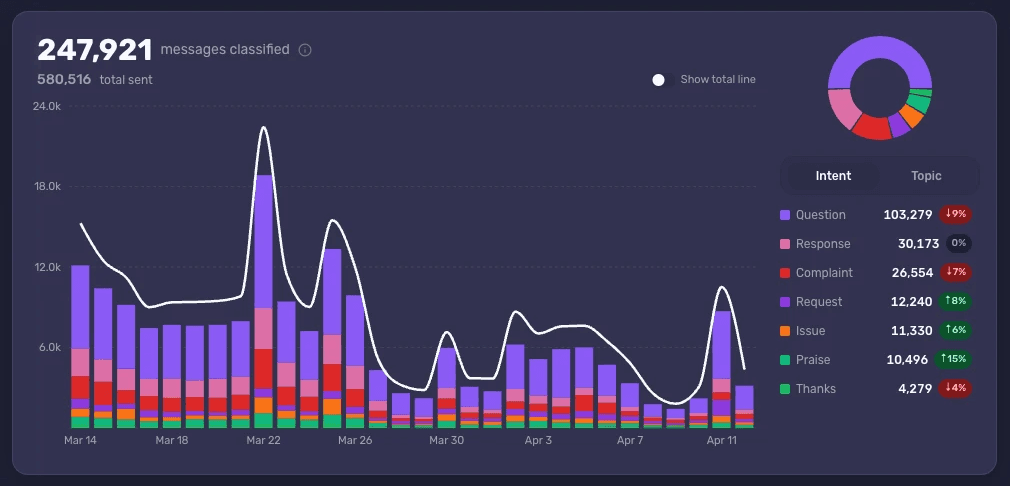
Community management is forward-looking and pattern-based. The job is reading what the community is collectively saying about your game and feeding it back to product, growth, and leadership. The skill is signal extraction. The tool stack — when it exists at all — is analytics, sentiment, cohorts, trend detection.
Studios that conflate the two end up with great moderation and zero community intelligence. The Discord stays safe. Nobody at the studio actually knows what the community thinks.
What moderation tools are built for
The moderation cluster on Roblox Discords is mature and mostly excellent. It handles a tight set of concerns:
Removing or filtering messages that violate rules.
Tracking user infractions over time and escalating accordingly.
Verifying identity (Bloxlink, RoVer) so bans actually mean something.
Handling raids, mass-join attacks, and account-age abuse.
Automating staff workflows, applications, and shift rotations (Hyra, Melonly).
If your moderation stack is doing these things well, leave it alone. The point of this post isn't to suggest you replace any of it.
What community managers actually do
The CM job is bigger than the role description usually admits. On a healthy Roblox studio it includes:
Reading the server enough to know what players are talking about, and how that's changing week to week.
Catching emerging Topics — a balance complaint, a UI confusion, a creator on TikTok pushing a controversial build — before they're a meeting.
Differentiating signal from noise: the loud weekend complaint thread vs. the slow-moving veteran consensus.
Translating community vibe into concrete, sourced findings the producer can act on.
Defending the community's perspective inside the studio, including when leadership wants to ship something the players will hate.
Tracking sentiment around updates and turning that into go/no-go calls on hotfixes and rollbacks.
Notice how little of that is "remove bad messages." A moderation stack literally cannot do any of this work, because it isn't designed to.
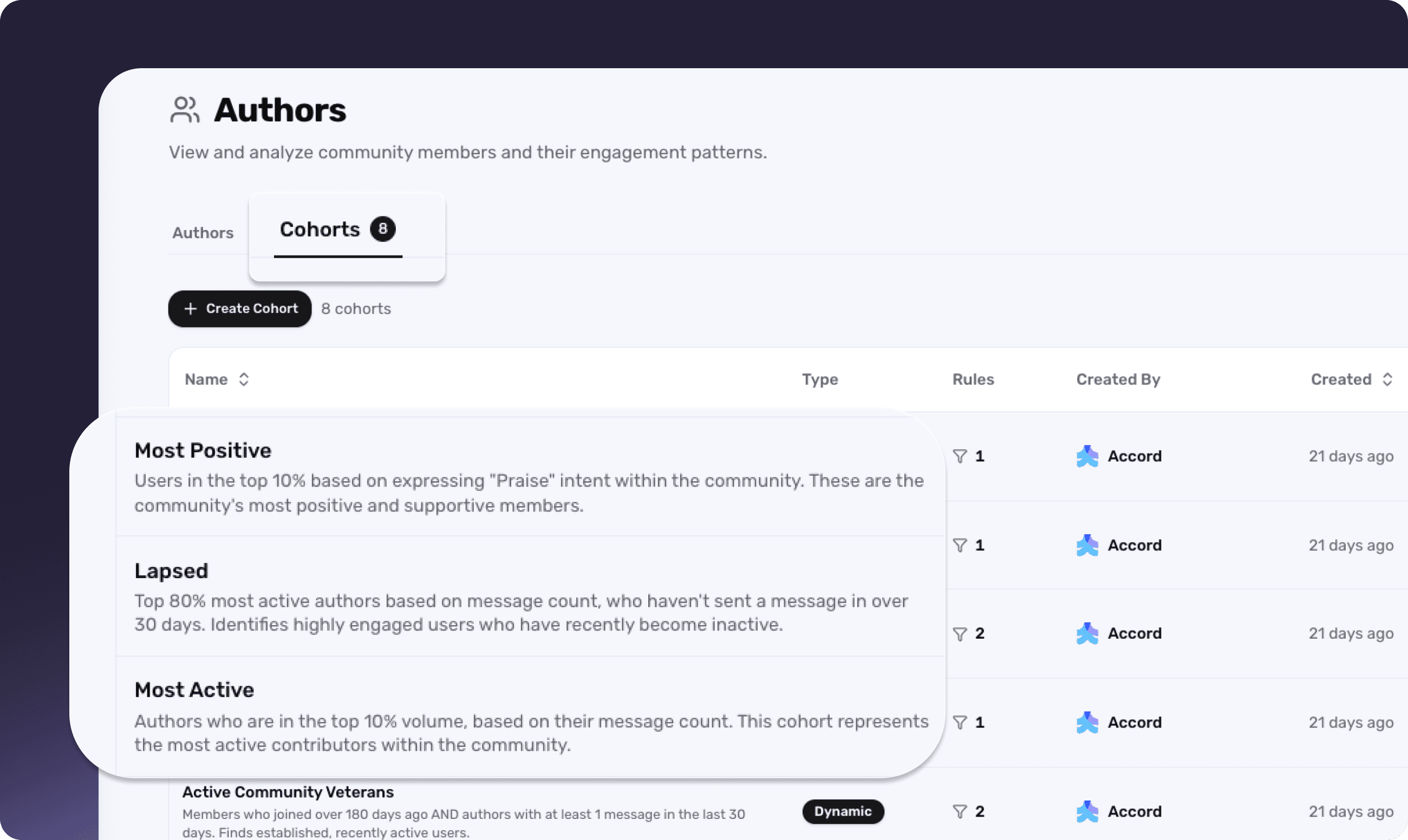
The closest thing the moderation stack has to community-management features is "user activity tracking" — but that's about staff, not about players. A staff activity dashboard tells you which moderator handled how many tickets. It doesn't tell you whether your players are happy.
Why the gap matters at scale
Below ~50k Discord members, a sharp CM can hold both jobs in their head. They moderate when something flares up, and they read the server in the gaps. The work is extensive but tractable.
Above 100k members, the gaps stop being gaps and become permanent blind spots. The CM falls back to whatever subset of the community is loudest, because that's the subset they can actually keep up with by scrolling. New-account complaint waves get amplified because they're recent. Quiet veteran disengagement gets missed because it's quiet by definition. The moderation stack stays fine. The community-intelligence work stops happening, even though the title hasn't changed.
This is where Roblox studios start making bad calls based on Discord. Lowering the price of a developer product because one cluster of new accounts complained loudly. Reverting a balance change because the loudest voices were also the worst at the new build. Missing a creeping retention problem until the CCU graph forces it into a meeting.
The studios making sharp calls have a different stack: moderation tools doing moderation, plus a separate layer doing the reading.
The three-part stack a Roblox CM needs
A Roblox community manager who's also doing growth and patch notes shouldn't be ranked on bot count. The stack that supports the actual job has three layers:
Moderation and ops. Whatever combination of Bloxlink, Hyra, RoVer, Melonly you're already running. Keep it. It's not the bottleneck.
Funnel. Webhooks for bug reports and player feedback, with a pipeline behind them that clusters and prioritizes so the channel isn't write-only.
Reading. Topic and Intent classification, cohort filters, sentiment trends, update comparisons. This is the layer that turns the Discord from a comms channel into a source of intelligence about your game.
The first two layers your studio probably has. The third is the one most Roblox studios are missing, and the gap is invisible until you compare yourself to a studio that has it. Then it's obvious.
Community management isn't moderation. The tools shouldn't be either.
See what Accord adds to your Roblox community manager's stack — book a demo.