Turning Discord bug reports into a prioritized queue
Most Roblox studios have already done the hard part. The webhook is wired up. Players can submit bug reports through a GUI in-game, or directly in #bug-reports on Discord. The reports are arriving. The harder part — and the part nobody on the DevForum has a clean answer to — is what happens next.
Reports without prioritization are just noise with timestamps. This piece walks through how to turn that channel into a queue your producer will actually look at on Monday morning.
Why bug-report webhooks aren't enough
The standard Roblox setup is a webhook from your game pushing player reports into a private Discord channel, sometimes accompanied by screenshot uploads or a simple Discord bot that lets players file reports without leaving chat. The DevForum has hundreds of threads on how to build this. The setup advice is solid.
What the setup advice never covers is the side effect. The webhook channel becomes the highest-volume channel in your server within a week. Engineers stop reading it because it's overwhelming. Community managers can't tell which reports are duplicates. The same crash gets reported 40 times by different players in slightly different words. By the time someone gets around to triaging, half the reports are stale and the other half are unreproducible.
The webhook did its job. The pipeline around it is what's missing.
Three jobs your bug pipeline has
A working bug pipeline does three things in order:
Cluster — group reports that are talking about the same thing, even when the wording differs.
Score — rank clusters by how many players reported the issue, how reproducible it is, and how recent the reports are.
Hand off — surface the top clusters to engineering with the underlying reports and quotes attached, in a format that doesn't require someone to manually retype anything.
If your current setup is "the CM reads #bug-reports and pings someone in #dev," you don't have a pipeline. You have a person doing the pipeline by hand, and that person is the bottleneck.
From Discord chaos to a real queue
Accord clusters reports automatically. Messages classified as Issue or Complaint, on Topics that map to bug behaviour, surface as ranked clusters with the underlying messages and players attached. You stop reading the channel and start reading a queue.
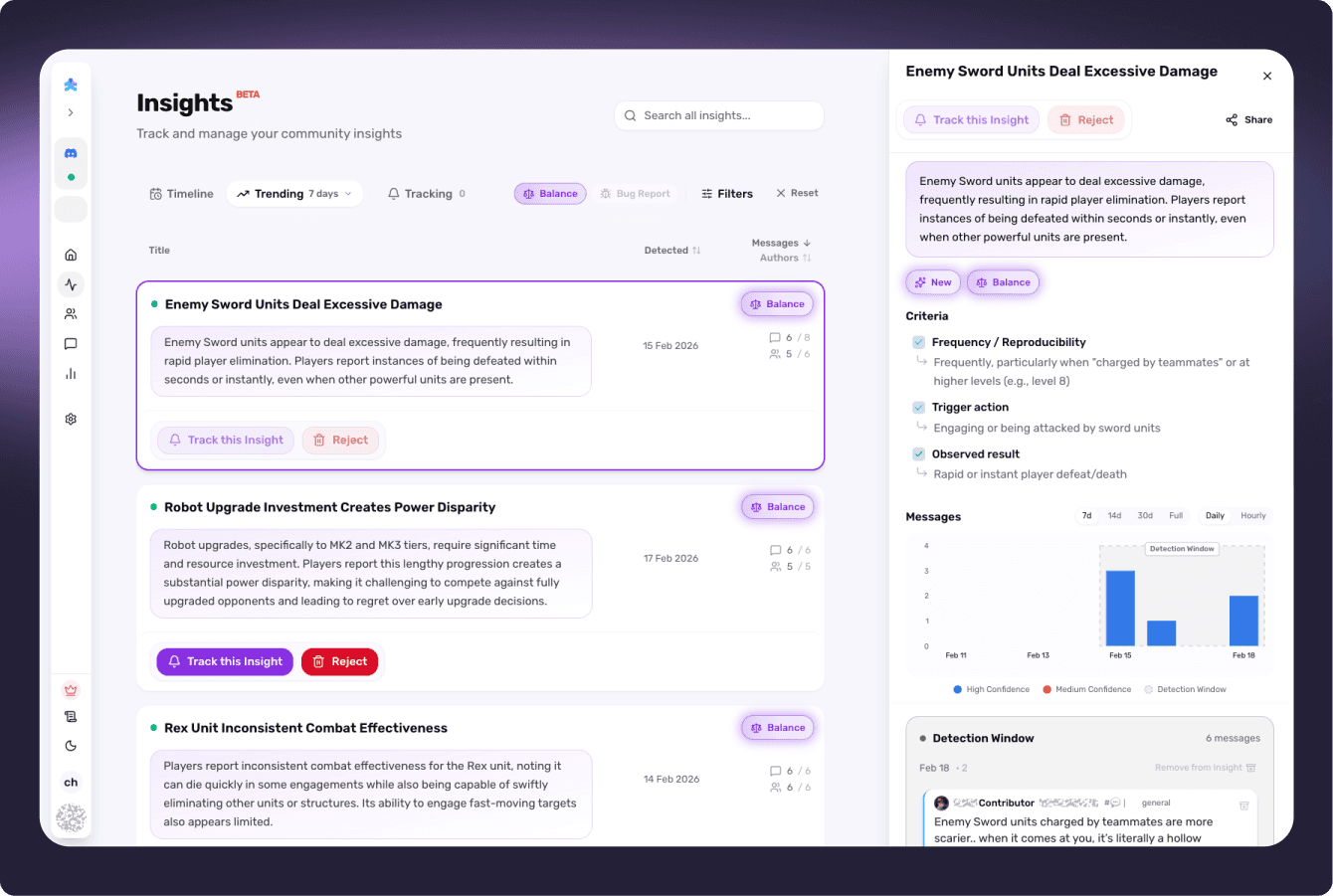
A cluster usually looks like this: one named issue ("Enemy Sword Units Deal Excessive Damage"), an aggregate count of how many distinct players have reported it, the date range of the reports, sample quotes, and a recommended impact and reproducibility score. The producer doesn't need to read 40 messages. They read one row.
This is also the layer that catches the duplicates the human eye misses. Two players describe the same crash in entirely different language ("the boss kills me when I dodge" vs. "I die during the fight even after the I-frame") and they end up in the same cluster. A CM scrolling the channel might never have noticed.
Adding the impact and reproducibility cuts
Volume of reports is a starting cut, not the whole story. Two more cuts make the queue trustworthy:
Reproducibility. Bugs that can be reliably reproduced get prioritized over ones that one player saw once. The Insights view surfaces this from the report content itself — phrases like "happens every time" and step-by-step descriptions weight a cluster higher.
Affected cohort. A bug that's biting your veteran cohort is more expensive than a bug that's biting accounts created today. Veterans churn quietly when their experience degrades; new accounts churn anyway. Filter the queue by cohort and the priority order can flip.
Layer these on top of raw volume and the queue starts looking like the list a producer would have built by hand if they had three days to read the channel.
The weekly bug review your producer will actually look at
The output of all this should be a 15-minute Monday review, not a 90-minute one. Build a saved Report for the weekly bug pipeline:
Top 10 issue clusters by combined score.
Each cluster's volume change versus last week (use sparkcharts).
Top three clusters affecting the veteran cohort specifically.
Anything brand new that didn't exist last Monday.
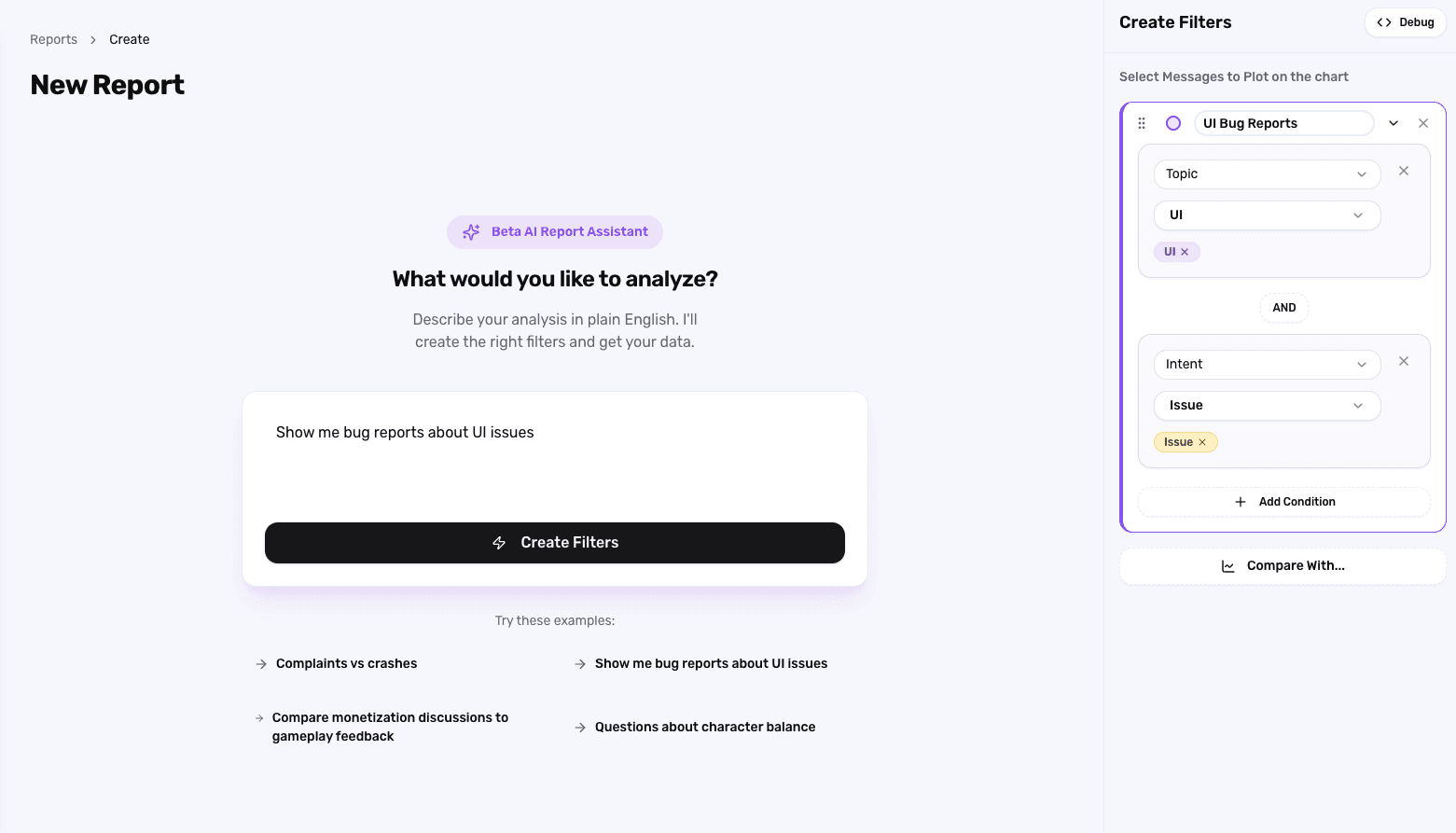
The producer scans this once on Monday. They flag what goes into the sprint. The CM opens the same Report on Wednesday to see what shifted. Engineering opens it after standup to triage. Three people, one source of truth, no #bug-reports scroll-fest.
This is the same logic that powers a day-one read on update health, applied to the steady-state stream of reports rather than the spike around a launch.
What this gets your studio
Roblox is a platform where small studios compete with full-team game companies. The studios that win are the ones whose feedback loop is shorter — bug filed, bug clustered, bug prioritized, bug fixed, players told. Most of that loop is engineering speed. The two ends of the loop, intake and prioritization, are where Discord either helps you or buries you. If your current pipeline is "the CM reads the channel," you're carrying load that the rest of the industry has automated.
See what Accord turns your Discord bug stream into — book a demo.