Case Study
How one Discord complaint nearly steered Essential Mod wrong & Accord Saved the day


Full Transcript
I'm Greg, or Gregory, Castle. I am the Growth Community Manager over at Spark Universe, specifically for their Essential Mod. Essential Mod is a 700-plus-thousand-strong community. It is one of the largest gaming communities out there.
We are primarily on Discord. Discord, on the surface, pretends that it is a forum like Reddit — where many users can all come together in one place and discuss things, complete strangers come together and talk about things en masse. But under the hood, it's a WhatsApp group. It's a Facebook Messenger group. It's an MSN chatroom — if you're old enough to know what MSN is. The capacity to get strangers to talk with each other at the level and the amount they do in Discord is truly amazing, but it does offer up a lot of challenges.
What does the community not only think about Essential Mod as it is now, but what ideas are surfacing about things that they want? Unless my full-time job was to just read the Discord server — which very much isn't — I wouldn't ever have been able to give them a solid answer. And until we had Accord, I was giving them answers as we found them. But we knew that there was more we could unpack from this community, because it is just so vast and there are so many ideas living there. And we really wanted a way of being able to extract that information, turn it into data that we could actually work with, and just better the product going forward.
So really being able to understand the problems, the concerns that community had, allowed me to then realise: okay, this is where I need to bring in this idea, or do this thing, to engage the community in a different way. And more recently, with the introduction of cohorts, I've now been able to really dig down and tackle: okay, are we engaging our new users properly? Are we losing our veteran users? What groups of people do I really need to spend more time on? And that's already turned around our strategy again. It shows that Accord was built by someone who spent a bunch of time as a community manager before they made Accord.
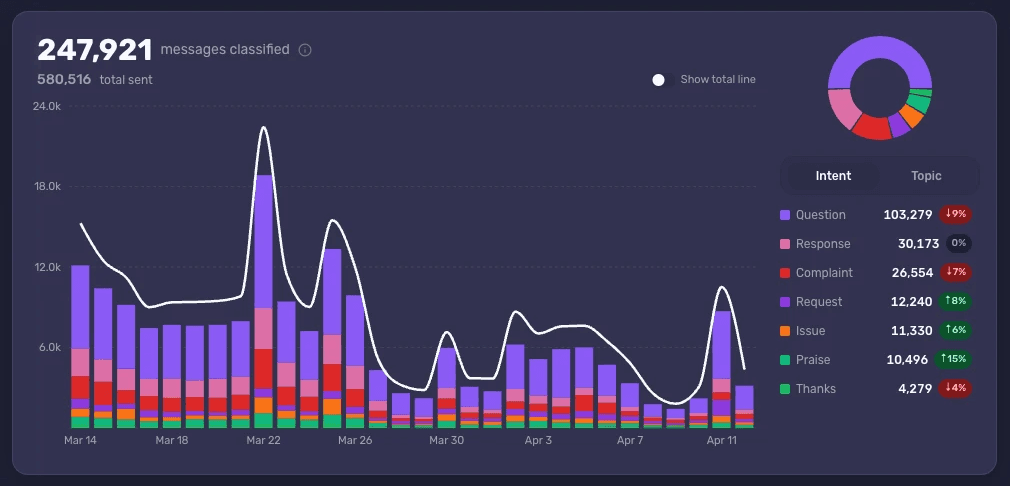
Accord is now one of the four things I click on when I open my computer in the morning. I have my emails, my calendar, my other sort of work tracking program, and now Accord. And this is the first thing I see every morning. I just have an immediate view of: okay, what is the server doing? Messages look on track. The active users — which is what I'm actively trying to grow — that looks on track. And then immediately, here are the things that were popping off while I was asleep. So if there's anything in there that is unexpected, I can immediately go in and dig into that.
Whether it's that, or just a general question that someone in management or another department asks me, I will come in here and run it as some sort of report with any question I have, and get some sort of feedback immediately from the community. Without that delay means that as a community team, I can work so much more quickly with my partners internally — compared to if I had to run a poll and say "hey, come back to me in 24 hours," or ask the question and leave it open for an entire week. I can get that information immediately. Nine times out of ten, I may well find something really useful just by running a quick report and finding some information there. So I live in this space. It's fantastic.
Accord is really central to the strategy that I'm providing for product. Knowing whether or not our community cares for that problem — whether it's something we should invest, quite frankly, a lot of development time in fixing — is really important. And Accord has really led the way with this, being able to query a large amount of community data at once (even data from before I was here) and get that immediate feedback of: okay, people are interested in this thing. How interested are they in this thing? Or sometimes, yeah, the community hasn't considered that in the past. But just being able to immediately get that from Accord means that it's not this massive amount of time that product need to wait. I can react to them very, very quickly and get that moving, you know, ASAP.
Just yesterday, a new user — which I was able to flag because it just came up as I was checking new user feedback — jumped into the server and was complaining left, right and centre about monetisation. Over-monetisation this, this problem, that problem. And from my sort of general reporting that day, monetisation was flagged as a problem. Had I just looked at my Discord server and gone to the team, then maybe we would have made an ill-advised change. But actually, through checking it at a cohort level and seeing that this was a new user complaining about this, and then being able to click through and check the context of that, find the Discord message and see that actually we have advocate community members, veteran community members, and other new community members responding to them saying, "No, no, it's fine, like, actually we like it this way, it's not pay-to-win or anything like this" — was actually able to allow me to give the opposite feedback to the team, which is: people are actually really happy with the monetisation at the moment, despite one or two, you know, sort of loud minority coming in and making waves.
So yeah, being able to dig into the community feedback at a really deep level is really, really important — not just for my own benefit, but [to avoid] potentially misleading the entire product and causing problems there.
Accord offers a wealth of data that Discord natively just does not. Discord's native metrics are, frankly, poor. Accord is a really nice complement to that. It has a lot of the important information I would like. It really has become an integral part of both my daily and weekly cycle.
Expand

Background
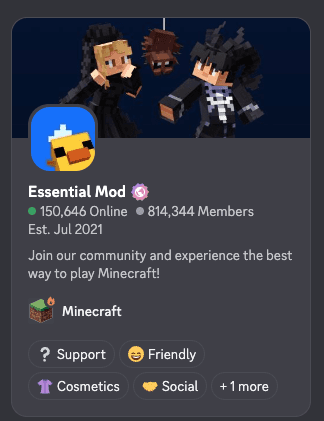
Greg Castle is the Growth Community Manager at Spark Universe, looking after Essential Mod — a Minecraft mod with one of the largest gaming communities on Discord, 700,000 members strong. His job is to take what those members say and turn it into something the product team can act on.
For most of that history, the gap between what the community thinks and what product knows was bigger than anyone wanted.
The Challenge
Discord wears the costume of a forum — many users, one place, ideas surfacing in the open. Under the hood it's a chat app: a WhatsApp group, a Messenger thread, an MSN room at scale. That's brilliant for getting strangers to actually talk to each other. It's bad for getting clean signal out the other end.
"Unless my full-time job was to just read the Discord server — which very much isn't — I wouldn't ever have been able to give them a solid answer."
Before Accord, that meant ad hoc answers. Product partners would ask what the community thought about a feature, and Greg's team would offer back whatever they'd happened to see. The community was vast, the ideas were there, but the workflow couldn't extract them. And Discord's native metrics weren't filling the gap — Greg calls them "frankly, poor."
The Solution
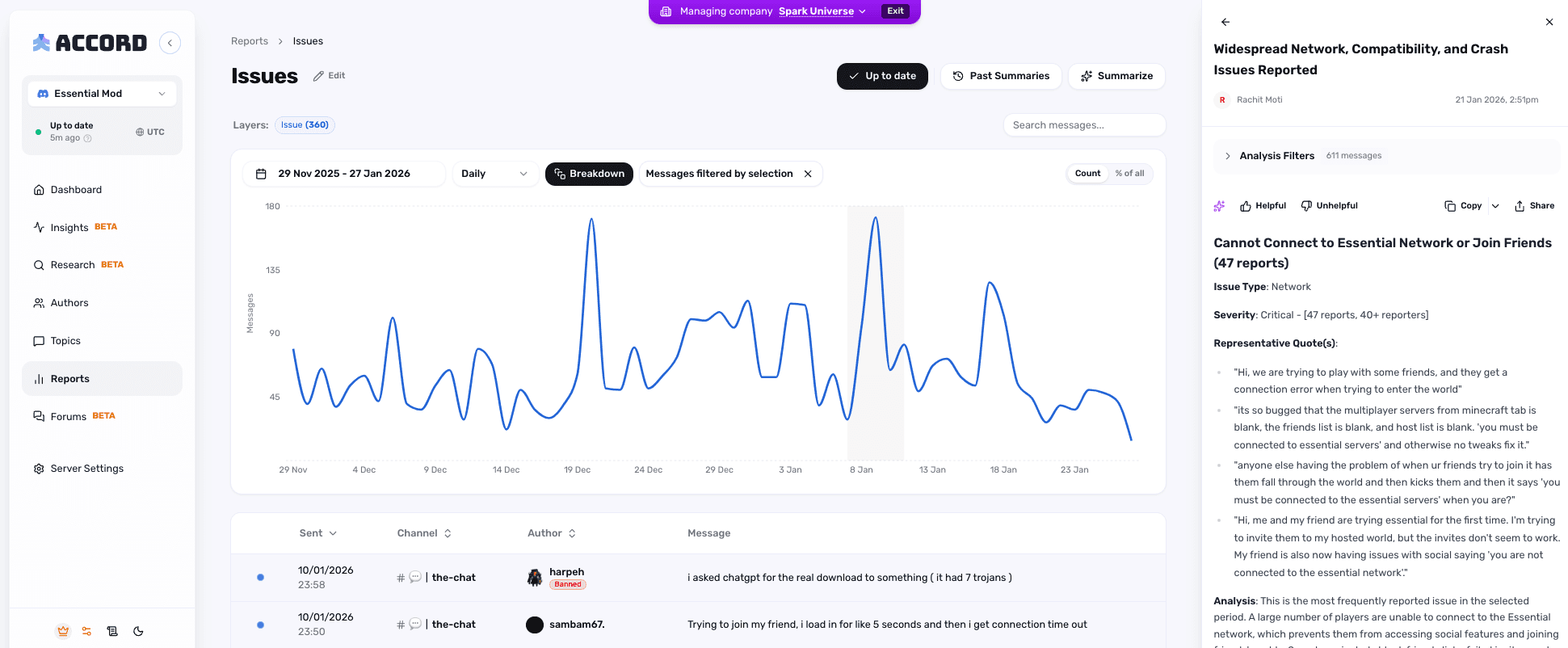
Accord became one of the four tabs Greg opens every morning, alongside email, calendar, and his work-tracking tool. The ritual is fast: what's the server doing, are active users on track, what popped off overnight. Anything unusual gets dug into on the spot.
When a question comes in from product or another team — what does the community think about X, how are we tracking on Y — Greg runs a report on the fly. The 24-hour poll cycle and the week-long open question, both gone.
"Nine times out of ten, I may well find something really useful just by running a quick report."
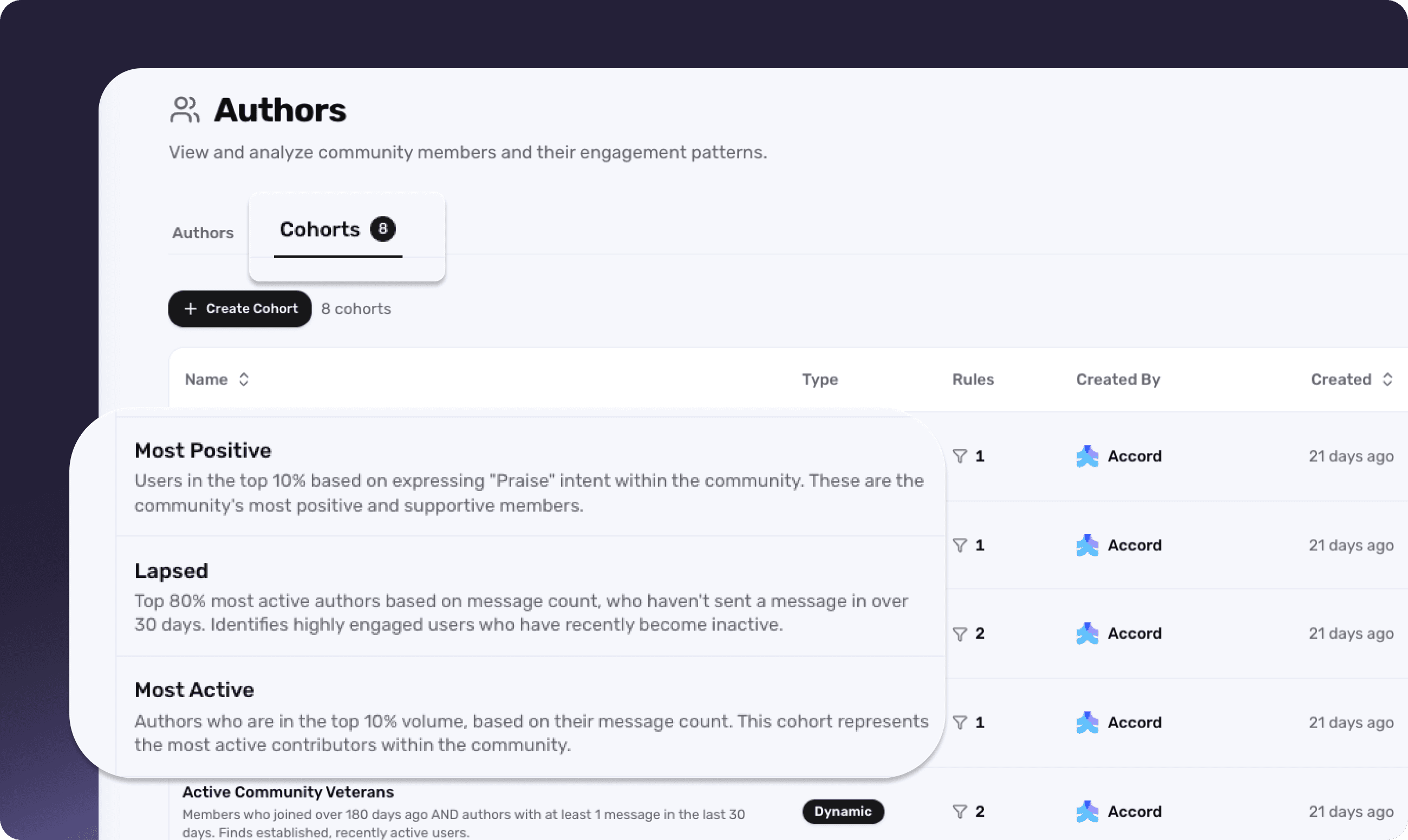
The introduction of cohorts pushed this further: slicing the community by new versus veteran members, identifying who needed more attention, and turning broad sentiment into something segmented enough to make real product calls on.
The Outcome
The clearest test came on a single monetisation question.
A new user dropped into the server and complained, loudly, about over-monetisation. The same day, Greg's general reporting flagged monetisation as a problem.
"Had I just looked at my Discord server and gone to the team, then maybe we would have made an ill-advised change."
Instead, the cohort view showed the complaint was isolated to a new-user voice. Clicking through to the original Discord post, Greg could see veteran members and other new users pushing back: actually, we like it this way, it's not pay-to-win. The feedback to product reversed direction. Most of the community was happy with where monetisation sat — one loud minority had nearly steered the ship.
That's the workflow shift. Community feedback at the cohort level isn't just useful — it's the thing keeping product from misreading itself.
"Accord is a really nice complement to Discord. It has a lot of the important information I would like. It really has become an integral part of both my daily and weekly cycle."
— Greg Castle, Growth Community Manager, Essential Mod