The Real Cost of Self-Moderating Your Discord Community
A studio's product lead asks the right question in a budget meeting: what does our Discord community actually cost us? The answer most studios give is one community manager's salary, plus a small line for Carl-bot Premium. Maybe $90,000 a year, all in.
That's the visible cost. It's also a fraction of the real one.
The full bill on self-moderating a Discord community at any meaningful scale includes things nobody adds up on the same spreadsheet: the cost of what the team is missing, the cost of inconsistency between CMs, the cost of CM burnout and turnover, and the slow opportunity cost of having a relationship-skilled person scroll chat for eight hours a day instead of building community programs. For a studio past about 50,000 messages a month, the line-item cost of in-house community work is a small fraction of the actual operational cost.
This is the conceptual math on what self-moderating a Discord community really costs. Not a tooling pitch — just visibility into what most studios miss when they budget.
What "self-moderating" usually means in practice
For a live-service game studio in 2026, self-moderating a Discord typically combines:
One to three studio-employed community managers, depending on community size.
A volunteer moderator team (5–20 people, often unpaid or stipended), drawn from active community members.
A moderation bot — Carl-bot, MEE6, Dyno — usually on a Premium tier at $5–50/month.
Native Discord features (AutoMod, audit logs, native polls).
A weekly summary written by the CM and forwarded to the product team.
Ad-hoc Reddit, social, and forum reads as supplementary signal.
The visible cost of this stack:
Line item | Annual cost (US, loaded) |
|---|---|
1 CM (mid-level, fully loaded) | ~$90,000–$130,000 |
Moderation bot premium | $60–$600 |
Volunteer mod stipends (if any) | $0–$10,000 |
Stated total | ~$90,000–$140,000 |
In Europe and most other regions, the salary line is lower but the structure is the same. That's the number that appears in the budget. It is not what the Discord actually costs.
The math of coverage
A community manager reading their Discord at a sustained pace covers roughly 5,000–8,000 messages of meaningful skim per workday — meaningful meaning enough to register topic, sentiment, and outlier patterns, not just scrolling past. Two hundred working days a year, that's 1.0–1.6 million messages of effective coverage per FTE-year, optimistically.
Lay that against typical live-service Discord volumes:
Server message volume | FTE coverage required for "read everything" |
|---|---|
20,000 / month (240k / yr) | ~0.2 FTE |
50,000 / month (600k / yr) | ~0.4–0.6 FTE |
100,000 / month (1.2M / yr) | ~0.8–1.2 FTE |
250,000 / month (3M / yr) | ~2–3 FTE |
500,000 / month (6M / yr) | ~4–6 FTE |
1,000,000+ / month (12M+ / yr) | ~8+ FTE |
Two implications. First, "1 FTE covers it" stops being true around 100k/month — and that's before the CM does anything except read. Real CMs also reply to DMs, attend producer meetings, coordinate events, do social-media work, write the summary, do Reddit reads. Effective coverage in a real job is half what the raw math says.
Second, the scaling is linear. Doubling community size doubles required headcount. Most growing live-service Discords cross 100k messages/month within the first year of a successful launch. By year two of a hit game, a studio that started with one CM at $100k is staring at a $400–600k annual community team if they continue the in-house-only path.
The hidden line item: linear scaling. This is the cost most budgets miss completely.
The cost of inconsistency
Different community managers reading the same server produce different summaries. When the producer asks "what does the community think about X?" — the answer depends on which CM ran the weekly read, which channels they prioritised, and which forum threads stood out to them that week.
The cost of inconsistency is invisible because it doesn't appear as a line item. It shows up downstream:
Product decisions made on a misread go to the roadmap.
Subsequent decisions stack on top of the previous misread.
Six months later, the team is shipping against a community state nobody on the team has a calibrated view of.
When the resulting product strategy underperforms, nobody traces it back to the CM-rotation week where the read drifted.
This is hard to price. For a live-service studio shipping weekly, the compound cost of multi-month strategic drift is easily six figures and often seven. It's also the most under-discussed cost of in-house-only community work.
The cost of missing things
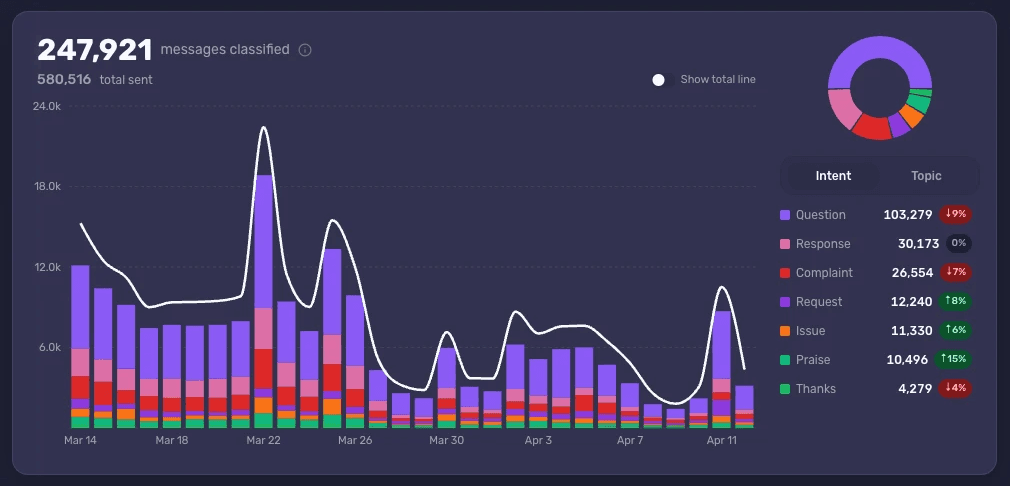
We covered the structural failure modes in the in-house community team post. The shorthand: at 50k+ messages/month, in-house manual reading misses slow-burn sentiment shifts, cohort drift (veterans going quiet), non-English sub-community signals, counter-narratives in chat channels, and update reactions that play out over weeks.
The cost of one of these misses, priced concretely: a misread monetisation reaction that ships into the next patch costs an estimated 1–3% in D14 retention for the affected cohort. Plug that into LTV math for a live-service game with even modest revenue per player — the answer is usually high six figures for one missed call.
One miss-prevented covers tooling for years. Most studios have multiple miss-events per year they don't connect back to community-read failures because they never had the structured data to make the connection.
The cost of CM burnout and turnover
Reading Discord for eight hours a day, every day, is unsustainable. The job that looks easy from outside ("just scrolling chat") is high-cognitive-load attention work that fatigues fast. Attention work also gets worse over the workday, not better — Friday afternoon reads are systematically lower-quality than Monday morning reads.
The implications:
CM turnover. Annual turnover on community-manager roles in gaming is high; industry data suggests it's well above general tech-industry averages.
Replacement cost. A turnover event costs $20,000–$40,000 in recruiting, training, and lost productivity — and that's before counting the 6–12 months it takes a new CM to fully understand a community's culture and inside-references.
Inconsistency spike. A new CM's first six months of summaries are reliably less accurate than a tenured CM's. The team is making decisions on impaired data for half a year after every hire.
Player relationship damage. Members had relationships with the previous CM. Rebuilding those takes months and is often the most-overlooked cost of CM turnover.
For a 2-CM team with one turnover per year (common for mid-sized studios), the hidden turnover cost is $25,000–$50,000 annually, on top of the visible salary line.
The opportunity cost
This is the biggest cost in the model and the hardest to price.
A community manager scrolling Discord eight hours a day is, by definition, not doing community work. Not running events. Not engaging with creators. Not coordinating with influencers and content creators. Not improving the new-player onboarding flow. Not building relationships with the top 50 community members. Not writing post-mortems on what worked last quarter.
The CM's actual skill — relational, judgment-heavy, creative work — is wasted on pattern matching at scale. Pattern matching is the wrong job for the wrong person. The opportunity cost of misallocating a relationship-skilled employee to attention-tax labour is hard to quantify, but it is reliably the largest item on the unwritten side of the spreadsheet.
A community manager freed from the reading job has time to do the work that actually compounds community value. That work — relationships, programs, content, events — is what differentiates a great live-service community from a mediocre one. It's also what the visible cost-of-self-moderating misses entirely.
What this looks like at three customer scales
A few concrete reference points from the studios we work with:
Savy Soda runs Pixel Starships 2 at roughly 10,000 messages/month. At this scale, in-house community work is genuinely sufficient — one CM with discipline can stay on top of it. Tooling is supplementary, not load-bearing.
Sandbox Interactive runs Albion Online at around 60,000 messages/month, multilingual. In-house works with effort; the language layer is where in-house-alone first starts to slip.
Paradox Interactive runs Hearts of Iron 4 at ~150,000 messages/month. In-house-only is no longer sufficient — the math of coverage and the multilingual demand cross the threshold.
MY.GAMES runs War Robots at 250,000+ messages/month. Manual-only reading is a fiction at this scale.
Wonder Works Studio runs SpongeBob Tower Defence at 500,000+ messages/month. An intelligence layer isn't optional.
At the upper end, some live-service game Discords clear a million messages a month at peak. No version of in-house-only works at this scale.
The pattern: there is a clear threshold around 50,000–100,000 messages a month at which the cost of staying in-house-only outstrips the cost of adding an intelligence layer. Below it, in-house is fine. Above it, in-house-only is the most expensive option, even if it doesn't look that way on the budget line.
The break-even calculation
For a studio in the 100,000+ messages/month range, the cost comparison roughly:
In-house-only at this scale:
2 CMs to cover the volume realistically: $180,000–$260,000
Annual turnover and replacement: ~$40,000
Estimated cost of 1–2 misses per year: $200,000–$500,000+
Opportunity cost of CMs doing scroll work instead of community work: unmeasured but large
Loaded annual cost: $400,000–$800,000+, with high variance and inconsistency
In-house + intelligence layer at this scale:
1 CM doing actual community work (not scrolling): $90,000–$130,000
Intelligence layer subscription: $1,000–$10,000/month depending on platform and volume
Cost of misses (substantially reduced via earlier signal detection): $40,000–$150,000
Loaded annual cost: $130,000–$300,000, with lower variance and consistent reads
These numbers vary by studio and by platform. The shape doesn't: past the volume threshold, the in-house-only path is more expensive and less effective, simultaneously, and the gap widens as the community grows.
The cheap diagnostic
Ask your CM team this exact question: "What's the most controversial topic in our Discord this week, and how does its volume compare to the same week last month?" Time how long they take to answer with confidence.
Under 5 minutes: in-house setup is working.
5–15 minutes: working with effort; getting fragile.
15+ minutes or "I don't know but I can find out": the in-house-only model has stopped working. The cost of every product-decision conversation that depends on this read is now elevated.
Multiply that 15-minute friction across every standup, every product meeting, every roadmap discussion in a year. That's the operational tax of running in-house-only past the threshold.
The honest version
Self-moderating a Discord community is the right call up to about 50,000 messages a month. Past there, the visible costs — CM salary, moderation bots — stop being the real costs. The hidden costs (coverage gaps, missed signals, inconsistency between CMs, burnout-driven turnover, opportunity cost of relationship-skilled people doing pattern-matching) are what determine whether the in-house-only setup is actually working.
For studios past 100,000 messages a month, the math of in-house-only stops working. Most teams don't notice because the visible line items stay constant; the hidden ones bleed out across product decisions, retention, and the slow underperformance of an over-stretched community team. The most expensive version of in-house-only community work is the one where nobody's added up what it's actually costing.
See what Accord surfaces in your Discord community — book a demo.