What Discord Emojis Tell You About a Game Community
A player drops a message into #patch-feedback: "great new balance patch 🙃." The community manager scrolling on Monday morning reads "great new balance patch" and registers it as positive. A standard sentiment classifier doing the same thing scores it positive too. Both are wrong. The emoji is doing the entire semantic work of the sentence; without reading it, you've read the message backwards.
This is the most common pattern in a game-community Discord. The emoji isn't attached to the message — it is part of the message's meaning. Reading Discord without reading emojis is reading at half-volume.
We covered reactions on messages in the previous piece on votes vs. reactions. This is the companion: what emojis in messages actually tell you, and why dropping or generic-positivising them is one of the most costly silent failures of community analysis.
The four functions emojis serve inside messages
Most emojis-in-text fall into one of four categories. Each carries a different kind of signal.
1. Tone modifier — the meaning-flipper
The emoji changes or qualifies the literal text. "Great patch 🙃" is sarcastic. "Sure, love the new monetisation model 😐" is dry mockery. "Fixed the bug 🙃" (from a mod) is self-deprecating about how long it took.
This is the emoji function most often missed. The classifier reads the words; the emoji flips them. Without parsing both together, the sentiment of every sarcastic message in your server reads as the opposite of what it actually means. In gaming communities, where irony is a dominant register, this misclassification is structural.
2. Emotional intensity — the amplifier
The emoji intensifies what the words already say. "This is broken 😩" is more frustrated than "this is broken." "Love this update 🥹" is more affectionate than "love this update." "Why is this here 😭" is more exasperated than "why is this here."
Intensity emojis don't change polarity; they scale it. For pattern detection across many messages, the intensity matters: a thousand mild "I don't love this" messages and a hundred "I HATE this 😩😩😩" messages aren't the same temperature, even if a flat sentiment count makes them look comparable.
3. Cultural shorthand — the dialect
A category-specific emoji used as a compressed substitute for words. "Devs are coping 🤡" — the 🤡 is the verdict, the rest is preamble. ":sus: that ratio" — the custom emoji is the entire point. "That's a 🚩" — the player has classified the behaviour as a red flag, full stop.
These emojis work as nouns or verbs, not as decoration. Strip them and the message reads as a fragment. Read them generically (as "negative emoji = negative") and you miss the specific classification the player made.
4. Pure-emoji response — the standalone message
A message that's only emoji. 💀💀💀 in response to a thread. 🤡 as a reply. 👀 to an announcement. These aren't reactions to the message — they're full responses chosen for brevity.
Pure-emoji messages are often discarded by pipelines that strip emojis or skip "short" messages. They shouldn't be. A 💀💀💀 reply to a complaint thread is a substantive "this is so bad it's funny" commentary; a 🤡 reply to a feature pitch is a substantive rejection. Both belong in the dataset.
Unicode vs custom: two semantic systems
Game-community Discords use two distinct emoji systems, with different reading rules.
Unicode emojis — 🔥 👀 💀 🤡 😭 🥶 🗿 — render the same everywhere and carry semi-shared meanings across communities. Semi-shared is doing real work in that sentence: Unicode emoji meanings have drifted dramatically over the last several years, and a classifier built on 2019 conventions reads 2026 messages wrong half the time.
A non-exhaustive list of meanings that have shifted:
💀 — meant death originally; now overwhelmingly means "I'm dead [laughing]", an intensity-of-amusement marker.
🗿 — stoic detachment, often dismissive; "unbothered."
🤡 — mockery, "you're being ridiculous," directed at the recipient.
😭 — has split into intense crying OR intense laughter, distinguishable only by context.
🥶 — "cold-blooded," impressive; not literally cold.
🙏 — thanks, please, or pleading depending on context.
🔥 — strong endorsement; not literal heat unless paired with text.
Reading a Discord with 2019-era Unicode meanings will systematically misread the gaming-dominant intensity-of-amusement uses of 💀 and 😭. A classifier that has been kept current — or that learns from per-server context — reads them correctly.
Custom server emojis — :pepehands:, :sus:, :copium:, server-mascot reactions repurposed as expressive tokens — work differently. They have meanings agreed locally, by the community on that specific server, and those meanings shift over time within the same server. A custom emoji that meant playful disagreement six months ago may have shifted into aggressive mockery this month after some specific incident. There is no global emoji dictionary that captures this; only per-server tokenisation does.
The implication: any pipeline that treats custom emojis the same way it treats Unicode emojis — mapping both into generic positive/negative scales — collapses the dialect into noise.
Emoji repetition is intensity, not duplication
Single emoji vs. cluster usage:
😭 = wry sadness OR mild amusement
😭😭😭 = "this is so funny I'm dying" — unambiguous intensity
💀 = "dead laughing" mild
💀💀💀 = "extremely funny / extremely bad"
🤡 = mockery
🤡🤡🤡 = the speaker is calling out something as a multi-clown-level absurdity
🔥 = good
🔥🔥🔥🔥🔥 = exceptional praise
Repetition isn't redundancy — it's volume control on the emotional signal. Reading three 😭s as the same signal as one 😭 is the same error as reading "this is funny" and "this is the funniest thing I've ever seen" as identical sentiment.
Cross-language emoji usage
For multilingual game-community Discords — EVE Online, Hearts of Iron 4, Albion Online, War Robots — emojis are often the most consistent cross-language signal. A Russian-speaking player using 💀 and an English-speaking player using 💀 are conveying the same intensity-of-amusement. The shared symbolic vocabulary crosses language barriers in ways the words themselves don't.
This makes emoji reading more important in multilingual servers, not less. A classifier that handles English-language emoji well but treats German or Korean text as a black box can still extract signal from the emoji layer. The emoji layer also normalises across languages when generating aggregate views — "complaint intensity in #general-de vs #general-en this week" is a comparison that mostly runs on the same emoji vocabulary regardless of which words are around them.
What stripping emojis costs
Pipelines that drop emojis before classification (more common than it should be) lose multiple distinct signal layers at once:
The sarcasm flips vanish — every ironic message reads as its surface text.
Intensity disappears — "this is broken 😩😩😩" becomes indistinguishable from "this is broken."
Pure-emoji responses are discarded entirely, removing a meaningful fraction of the dataset.
Cultural classifications the players themselves made (the 🤡 verdict, the 🚩 flag) are erased.
Custom-emoji dialect is collapsed.
In practice, a Discord message corpus with the emojis removed is missing 30–40% of the semantic content. Sentiment scores on emoji-stripped data are reliably wrong on the sarcasm-heavy game-community subset. The classifier looks like it's working because it returns numbers; the numbers describe a sanitised dataset that bears decreasing resemblance to the actual conversation.
How Accord handles emojis-in-messages
The principles, in plain language:
Emojis are kept and classified, not stripped. Every emoji in a message contributes to the message's intent assignment.
Tone-modifier emojis can flip parent message intent. A praise-shaped message with 🙃 attached is scored as Complaint or Issue, not Praise — the emoji has more weight than the surface words in those cases.
Repetition is treated as intensity. Three 😭s carry more weight than one.
Pure-emoji messages are classified as their own message type, not discarded.
Custom server emojis are tokenised per-server, with the community-specific meaning inferred from how the emoji is used in context across that specific Discord.
Cultural drift is recalibrated regularly, because Unicode emoji meanings genuinely shift over time. A model frozen in 2019 reads 2026 messages backwards on a meaningful share of cases.
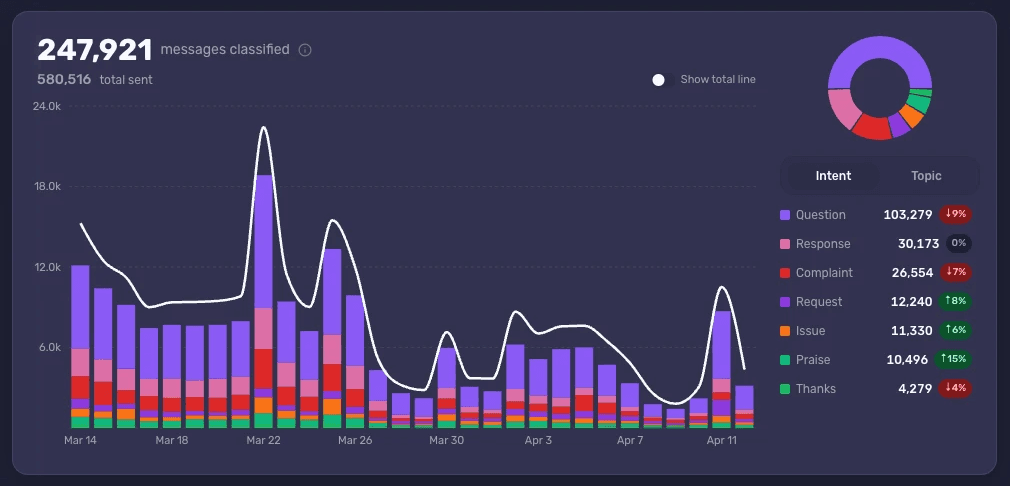
The output: when a player writes "great new balance patch 🙃," the message lands in the Complaint bucket, not Praise. When a thread accumulates fifteen 💀💀💀 responses to a player's monetisation complaint, those count as amplified-agreement signal, not random emoji noise.
The cheap diagnostic
Pick a recent emotional thread in your Discord — a controversial patch, a price change, an event reaction. Strip the emojis out of every message in the thread and read the text alone. Does the thread tell you the same thing? In most cases, the answer is no — the sentiment swings, the sarcasm vanishes, and the community's actual position becomes ambiguous.
If your current pipeline (or your current manual reading) does the equivalent of that strip, you're operating with the wrong half of the data.
The honest version
An emoji in a Discord message is not decoration. It is, frequently, the most important word in the sentence — the part that flips meaning, scales intensity, or supplies the player's actual classification of what's happening. Reading game-community Discords without reading emojis is reading the dataset half-blind, regardless of how sophisticated the rest of the analysis is.
For a game community where irony is the default register and custom emojis are the dialect, emoji-aware reading isn't a nice-to-have layer. It's how you get the sentiment right.
See what Accord surfaces in your Discord community — book a demo.