What a Healthy Discord Patch Reaction Looks Like (And When to Worry)
Article
Every live-service patch lands in the studio's Discord with a recognisable shape. Volume spikes. Complaint-share spikes. Then both decay. The pace and the proportions vary by community, but the structure of a healthy patch reaction is remarkably consistent across the live-service games we work with — and so are the ways a bad patch breaks that structure.
Most studios read patch reactions Monday morning by scrolling the loudest forum thread and forming an impression. That works some weeks and fails others. The miss case isn't laziness; it's that "is the Discord upset?" is a poorly-formed question. The well-formed version is "is this patch's reaction shape diverging from the last three patches?" — and that one has a real answer if you know what shape to look for.
This is the conceptual anatomy of a healthy patch reaction, the four most common failure modes, and the signals that distinguish them.
The shape of a healthy patch reaction
Across live-service Discords that ship weekly content drops, healthy patch reactions follow a consistent three-phase arc:
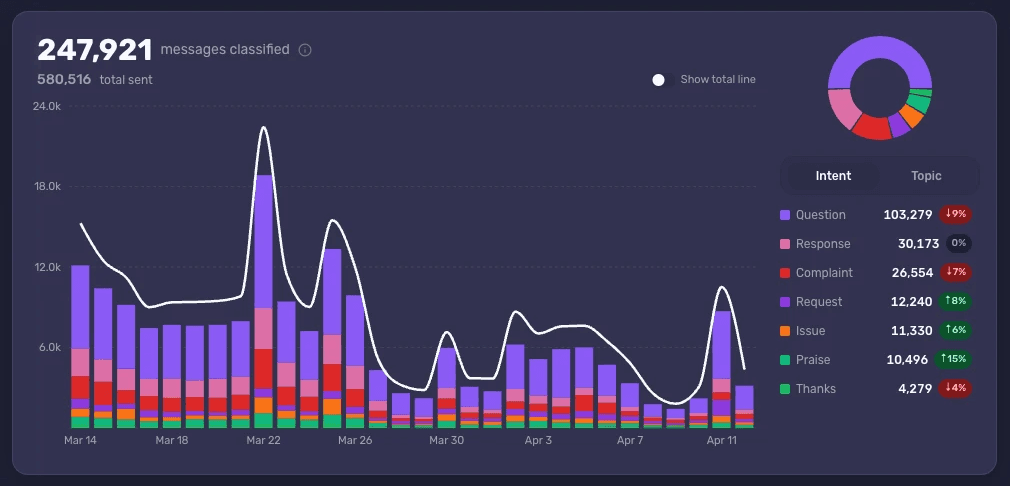
Phase 1 — Hot take spike (hours 0–6). Message volume jumps two to four times baseline. Intent mix lands roughly 40% Praise, 30% Complaint, 20% Question, 10% Thanks/Response/Issue. The community is loud. The praise comes from players who got what they wanted, the complaints come from players who didn't, and both are vocal because the patch is news. The texture of the reaction is mixed and energetic, not skewed.
Phase 2 — Settling (hours 6–24). Volume drops back toward 1.5× baseline. The praise-to-complaint ratio shifts toward Praise as the loudest critics finish posting and the broader community picks up. New players ask Questions; experienced players Respond. The conversation matures — fewer hot takes, more concrete observations. This is when the patch starts to land into the community's actual opinion rather than its first impression.
Phase 3 — Stable read (hours 24–72). Volume returns to baseline or slightly above. Complaint-share drops to within roughly 20% of pre-patch normal. The patch is now part of the game, not news. If complaint-share stays elevated past hour 36, the patch isn't landing — that's the divergence to read.
A healthy patch's Topic Breakdown across those 72 hours looks like a clean decay. A bad patch's chart shows complaint growing over hours 12–36 instead of decaying — that's the moment a vocal complaint thread is recruiting silent doubters into agreement.
The shape is recognisable in 90 seconds if you've watched it a dozen times. It's almost impossible to read off raw message scroll, regardless of how diligent the CM is.
Four ways a bad patch breaks the shape
When the reaction diverges from the healthy arc, it usually breaks in one of four characteristic ways. Each has a different underlying cause and a different correct response.
1. The slow-burn
Shape: Phase 1 looks normal — mixed reaction, expected complaint share. Phase 2 doesn't decay. Phase 3 complaint-share is higher than Phase 2.
Cause: A patch change reveals its real impact only after players have lived with it for 24+ hours. Common culprits: economy changes (price effects emerge as the in-game economy adjusts), progression changes (felt only after a play session), competitive balance shifts (felt only when a meta crystallises in PvP queues).
What to read: The hour-24-to-72 conversation. The first six hours misled the team into thinking the patch landed; the next 60 hours are the actual signal. If the Topic Breakdown in Phase 3 is dominated by a different subtopic than the hot-take phase, that's confirmation — players' problem turned out to be different from what they expected to complain about.
2. The subtopic-isolation problem
Shape: Overall complaint-share is elevated, but the Topic Breakdown shows complaints concentrated in a single subtopic while the rest of the patch is praised.
Cause: The patch shipped multiple changes. One of them is bad; the rest are fine.
What to read: Subtopic-level breakdown of the Complaint intent. "Season 12 patch" as a Topic might decompose into crit chance changes (praised), new boss difficulty (praised), cosmetic store update (neutral), matchmaking change (heavily complained about). If 70% of the patch's negative messages reference matchmaking specifically, the fix isn't to revert the patch — it's to revert one specific change.
This is the single most common producer-mistake-saving moment of structured patch reading: keeping a patch alive that shipped one bad component, by isolating the component.
3. The cohort split
Shape: Overall reaction looks neutral or even mildly positive. Veteran cohort reaction is strongly negative. New-player cohort reaction is strongly positive. They roughly cancel out in the aggregate.
Cause: A patch deliberately or accidentally widened the gap between new and experienced players. Common in difficulty rebalances, new-player onboarding shifts, and most monetisation changes.
What to read: The Intent breakdown filtered by cohort. The two views look like different patches. If the team is targeting new-player retention, the veteran complaints might be acceptable. If the team is targeting veteran LTV, the cohort split is a problem the aggregate hides. Either way, knowing the split changes the conversation.
The cohort split is the read that's almost completely invisible without cohort-aware analysis. Aggregate sentiment looks fine and the team ships the next patch on top of it; six weeks later veteran churn arrives, and nobody can connect it back to the patch because the data at the time looked clean.
4. The silent rejection
Shape: Phase 1 volume is lower than expected. The patch dropped and the Discord didn't react much in either direction. Forum threads are quiet. #general is quiet.
Cause: The patch was a nothing-burger. The team thought they shipped a major content drop; the community shrugged. This is rarer than the other three but worth flagging because it usually indicates a different problem — the team's product judgment is calibrated to internal excitement, not community demand.
What to read: Compare the patch's volume curve against the last three. If volume failed to spike, the patch landed as filler regardless of its internal weight. The product question is why this update didn't matter to the players — usually because what shipped wasn't what the community had been asking for.
The silent rejection is also the patch shape most often mistaken for "the patch landed fine" — quiet is fine, right? — when it actually means the patch didn't register. Distinguishing "fine" from "irrelevant" needs the comparison to past patches.
What the patch-reaction shape doesn't tell you
A healthy patch shape is not the same as a healthy patch. Three things the shape under-determines:
Long-term retention impact. A 72-hour reaction predicts the immediate reception, not the second-week or fourth-week impact. Some patches are universally praised in week 1 and quietly bleed players in weeks 3–4 once the novelty fades. The patch-reaction read needs to pair with the silence signal two and four weeks downstream.
Non-Discord channels. A great Discord reaction doesn't mean a great Reddit reaction or a great Steam-review reaction. For studios where Discord skews toward a specific player profile (often the most-engaged), the rest of the player base may have a different read. Cross-channel sentiment work is its own discipline.
Whether the team should agree with the community. Sometimes the community is right; sometimes they're not. A bad patch reaction doesn't automatically mean the patch was a mistake. The team's product judgment still has to do the work. What the structured read provides is information, not a decision rule.
Why this shape recognition matters more for live-service
For games shipping a major content drop once a year, getting the patch-reaction read wrong is recoverable. There's a year to course-correct.
For live-service games shipping weekly or biweekly, getting it wrong compounds. The week-2 patch ships on top of a misread of week-1's reaction. The week-3 patch compounds the error further. By week 6, the team is shipping on top of a community state nobody on the studio side has a calibrated read of.
That's the actual leverage of structured patch-reaction reading — not any individual week's call, but consistency across many weeks. The team that uses the same structured read every Monday has a 12-month track record they can audit when retention surprises them. The team that reads on impression has 12 months of unverifiable impressions.
The honest version
Every patch's reaction has a shape. The healthy ones look the same; the bad ones break in recognisable ways. Without structured reading, the shapes blur into a wall of messages that gets summarised differently every week depending on who scrolled which channels.
For live-service studios shipping weekly, the value isn't "we have analytics" — it's that every Monday's patch-reaction read produces a comparable answer to every other Monday's. That comparability, kept up over a year of patches, is the asset.
See what Accord surfaces in your Discord community — book a demo.