The Seven Intents That Shape a Game Community Discord
Article
The most common way game studios try to measure their Discord is sentiment — positive, negative, neutral, scored across messages. It's an old framing, borrowed from social listening, and it doesn't survive contact with a real game community. Sentiment treats "the new boss is way too hard" (a complaint about difficulty) the same as "this matchmaking is terrible, please fix it" (a request to repair a specific system) — both negative, both flagged the same way, both pulled into the same bucket on the same chart. But they map to different product responses, different urgency levels, different people on the team to escalate to.
A more useful frame is intent. What is the message trying to do? In a game-community Discord, virtually every message that isn't pure chat falls into one of seven intents. They aren't moods — they're acts. And the mix of those seven intents, week-over-week, is a richer community-health signal than any sentiment score.
The seven intents
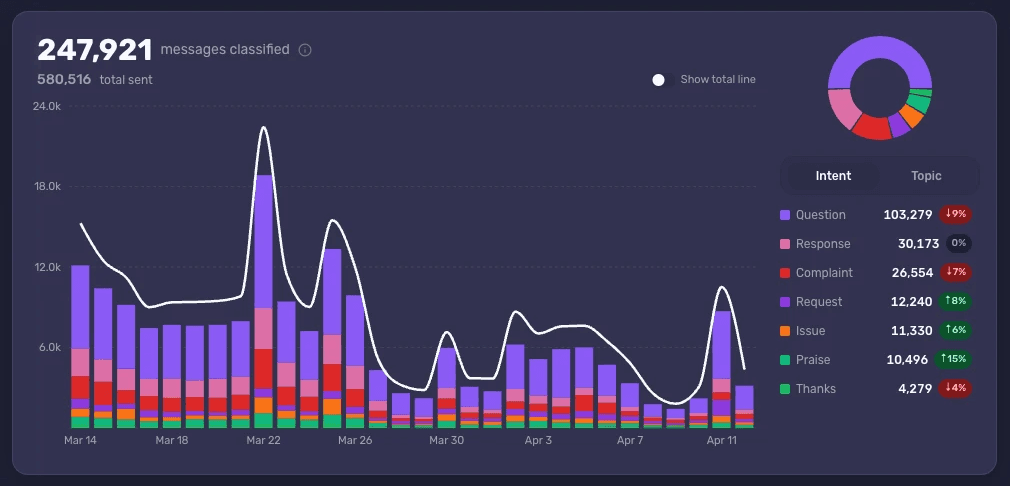
The taxonomy Accord uses across every classified Discord — sized to cover the actual range of what live-service players write, without overlap or category collapse:
1. Complaint
The player is unhappy and saying so, without proposing a fix. "This patch is awful." "The economy is broken." "Why is the new boss like this."
Complaints are emotional and unfocused. They're the loudest part of any patch reaction's first six hours. Read alone, they're misleading — high complaint volume in the first day of a patch is normal and decays. Read in context (ratio over time, by cohort, by topic), they're the most actionable signal in a live community.
Product response: rarely direct. Complaints inform whether the team is reading the room correctly. They get aggregated into a Topic, and if the Topic's complaint share stays elevated past 24–36 hours, the response is to look at the underlying change.
2. Request
The player is asking for something specific to change or be added. "Can we get a sort option on the inventory?" "Please add an auction house." "The matchmaking needs a queue-based system, not skill-based."
Requests are structured proposals. They're cognitively heavier than complaints — players are doing the work of framing what they want, which means the request channel is usually a different population from the complaint channel. (Loud complainers don't usually file structured requests; structured requesters often don't bother with raw complaints.)
Product response: direct candidate for the backlog. The aggregation question is whether this request has been made many times before, by many players, and whether the underlying theme matters more than the specific proposal.
3. Issue
The player is reporting a bug, a glitch, or something they think is broken. "The dragon's hitbox is wrong." "Clipping into walls on the southern map." "Voice chat doesn't work for me since the patch."
Issues are factual claims about a specific malfunction. The QA team is reading these; the community team should be too, because the volume of Issue messages is a leading indicator of build quality independent of the specific bugs reported. A patch generating 3× the Issue volume of the last patch's reaction is information about the patch's QA state — even before the bugs are triaged.
Product response: QA pipeline. The community-intelligence layer's job is making sure the Issues are findable and aren't lost in the noise of Complaints, and that the aggregate Issue trajectory is visible to the team.
4. Praise
The player is positive and saying so. "This patch is great." "Love the new boss design." "The economy fix worked perfectly."
Praise is the most underweighted intent in most community reads, because nobody escalates positive feedback the way they escalate complaints. But Praise volume — especially the praise-to-complaint ratio — is the cleanest read on whether a change landed. A patch with 40% praise and 30% complaint is usually a successful patch even if the complaints feel loud.
Product response: rarely direct. Praise validates the team's product calls. Tracking it over time prevents the trap of optimising only for the things players complain about while quietly losing the things they previously praised.
5. Question
The player is asking how something works, where to find something, or what something means. "Where do I get the new weapon?" "What does the buff icon mean?" "How does the new trading system work?"
Question volume is a tell about the clarity of recent changes. A patch that generates twice the Question volume of normal is a patch the team explained badly. Question volume also pairs with Response volume to indicate how well the community is teaching itself — a healthy community has experienced players answering newer players' questions without staff intervention.
Product response: UX/communication. If the same Question dominates the post-patch conversation, the patch notes failed at that specific change.
6. Thanks
The player is acknowledging something — a fix, an announcement, a moderator action, another player's help. "Thanks for fixing the lag!" "Cheers for the heads-up about the maintenance." "This community is great."
Thanks is the relational glue of a community. Low Thanks volume in a server that used to have it is a sign of erosion — players have stopped treating the team or each other warmly. It's a subtle signal but a real one. Communities don't fall apart in a single Complaint wave; they fall apart over months of Thanks disappearing.
Product response: community team direct. Thanks tells the team whether the community is in a good relational state with the studio, independent of whether they're happy with the product. Those are different.
7. Response
The player is replying to or following up on another message — agreeing, disagreeing, qualifying, building on. "Yeah this is true." "Actually I think the opposite — here's why." "To follow up on what they said..."
Response is the most context-dependent intent. A Response in isolation is meaningless; a Response chained off a specific Complaint or Request is what makes it signal-bearing. A high Response-to-other-intent ratio is the mark of a discussion-driven community where players engage each other; a low ratio is the mark of a soapbox community where everyone posts but nobody responds.
Product response: indirect but important. Response analysis is how counter-narratives get surfaced — the disagreements that don't get posted as top-level Complaints sit in Responses to other people's Complaints. Reading Complaints without their Responses overweights the OP's framing.
Why seven (and not three, or twelve)
The categories matter less for their individual labels than for the separations they enforce. Three-way classification (Positive / Negative / Neutral) collapses too much: Complaint and Issue end up in the same bucket; Praise and Thanks end up in the same bucket; Request gets lost entirely. Twelve-way classification over-fragments — separating "feature request" from "balance request" from "UI request" sounds precise but creates classification noise without changing the product response.
Seven is the level where each category maps to a distinct response and a distinct team. Complaints → community team's read; Requests → product roadmap candidates; Issues → QA pipeline; Praise → validates product calls; Questions → UX/comms; Thanks → relational health; Responses → context for everything else.
This is also the level where multi-language classification stays tractable. The same seven categories generalise across English, German, Russian, Spanish, Portuguese, Korean, and the other languages live-service communities run in. Adding more categories increases the risk of language-specific drift; fewer categories doesn't differentiate enough.
What the intent mix tells you that any single intent doesn't
The most useful read isn't any one intent's volume — it's the mix over time, the ratios between them.
A healthy live-service Discord usually sits around 25–40% Praise, 15–30% Complaint, 10–20% Question, 5–15% Issue, 10–20% Request, 5–10% Thanks, with Responses overlaid on top of all of these. The exact distribution varies by community and by week, but the shape stays roughly recognisable.
When the mix shifts, the shift itself is the signal:
Complaint share rising over weeks, Praise share falling — sentiment trajectory is going the wrong way. This is the slow-burn shift that no single day surfaces.
Question share spiking after a patch — communication failure. The team didn't explain a change well.
Issue share spiking — build quality problem, independent of how players feel about the patch.
Thanks share falling steadily over months — relational erosion, a different problem from any specific complaint.
Response share falling — discussion-thinning. Players are posting at the server, not with each other. Communities in this state are harder to recover than they look.
Each of these reads requires the intents to be categories, not a sentiment slider. Sentiment treats them as variations on positive-negative; the seven-intent frame treats them as distinct community states with distinct responses.
The cross-link to other intents
A useful side effect of intent classification: messages relate to each other across categories in legible ways. A Complaint about an Issue, followed by Responses from veterans, followed by a Thanks when the issue is fixed, is a recognisable arc. The same arc looks like five disconnected messages in a pure-sentiment view.
Tracking this kind of arc — how a Topic's intent mix evolves — is the deeper read that intent classification enables. A patch that lands fine looks like Praise + Question + Response in the first 24 hours, with Complaint and Issue decaying. A patch that doesn't land looks like Complaint + Response growing while Praise and Thanks shrink. The arc is the diagnosis.
The honest version
Sentiment is too thin to read a live game community. The mix of what messages are trying to do — complain, request, report, praise, ask, thank, respond — carries more information at every level: per-message, per-Topic, per-cohort, per-week. The categories are the structure on top of which everything else (cohort analysis, patch-reaction reading, silence-signal cohorts) sits.
For a live-service team trying to understand its Discord at scale, the upgrade isn't more dashboards. It's the right categories — and seven is the right number.
See what Accord surfaces in your Discord community — book a demo.