The 2026 Multilingual Game Discord Guide
Article
EVE Online runs in five languages on any given day. Hearts of Iron 4 in seven. Albion Online in eight. Most live-service game Discords past 50,000 members are multilingual by default — and most "Discord analytics" tools quietly assume the server is English-only, classifying or quietly dropping anything else.
That assumption isn't visible from a dashboard. It shows up two weeks later when the German-language sub-community has been complaining about a balance change the whole time and nobody on the studio's mostly-English community team noticed. By the time a localised support ticket lands, the discussion has been happening for fifteen days in plain sight.
This is the comprehensive 2026 reference for what it actually takes to read a multilingual game Discord — what the structure looks like in practice, where standard tools fail, and the capabilities a community-intelligence layer needs to handle it.
Why game Discords are multilingual by default
Most game studios outside the largest US-headquartered publishers ship to a global audience from day one. Three structural reasons their Discord communities end up multilingual:
The game ships in multiple languages. Steam, Microsoft Store, Epic, and platform-store distribution support 20+ languages out of the box. A game with German, French, Russian, Brazilian Portuguese, Spanish-LatAm, Japanese, Korean, and Simplified Chinese localisation ends up with players from every one of those regions in the Discord.
Live-service communities pull beyond the localisation set. Even games shipped in English-only often see organic Russian, Turkish, Indonesian, and Vietnamese sub-communities form once player count exceeds a few hundred thousand. Multiplayer games especially — players want to coordinate with squadmates who share a language.
Discord's regional reach. Discord's strongest growth in 2023–2025 was in non-US markets. EU, LatAm, and Southeast Asia communities are now meaningful slices of any successful live-service game Discord.
The result: a Discord that's nominally English-language often has 20–40% of its messages in something else. For studios based in non-English-speaking countries — Sandbox Interactive (Berlin, Albion Online), CCP Games (Reykjavik, EVE Online), MY.GAMES (Amsterdam, War Robots), Paradox Interactive (Stockholm, Hearts of Iron 4) — the multilingual share is often higher and the implicit language is German, Icelandic, Russian, or Swedish, not English.
Three common structural patterns
The structure of multilingual game Discords varies, but three patterns dominate:
1. Language-prefixed channels
The most common setup. Channels like #general-en, #general-de, #general-ru, #general-es. Each language has its own parallel set of channels. The English channels are usually the largest and where global announcements land; the others are organic communities of native speakers.
Strength: Players land in their language; conversation stays focused. Weakness: The server runs as several parallel sub-communities with limited cross-language traffic. A patch reaction can play out completely differently in #general-en vs. #general-de and the studio only sees one.
2. Regional categories
Larger servers (200k+ members) often split by region rather than just language: EU, NA, LATAM, APAC, RU/CIS as Discord category groupings, with each region having its own channel set. Often combined with language.
Strength: Captures playtime overlap (EU and APAC players run on different schedules; latency matters). Weakness: Same as language-prefixed, scaled up — even harder to read across regions.
3. Single-language channels with mixed-language posting
Some smaller or younger Discords run as "English-primary" but tolerate (or quietly welcome) other languages mixed in. A #general channel where the dominant language is English but 20% of posts are in Spanish, Portuguese, and Russian.
Strength: No fragmentation; everyone's in the same room. Weakness: Any analysis or classification that runs English-only silently ignores the 20%. The team thinks they're reading the whole channel; they're reading the English half.
The third pattern is the most common and the most dangerous, because the gap is invisible. Pattern 1 and 2 at least signal "there are other languages here" by their channel structure. Pattern 3 hides it.
Where standard tools fail
Most Discord analytics tools handle the multilingual problem in one of three unsatisfying ways:
Drop non-English messages silently. The most common failure mode. The classifier returns "low confidence" on a German message and the pipeline excludes it. The dashboard shows clean numbers; the German sub-community is invisible.
Translate first, classify second. Pipe everything through Google Translate or DeepL, then run an English-trained intent classifier on the translation. Two problems: translation costs add up at high message volumes (six-figure annual bills aren't unusual at 1M+ msg/mo), and translated text drops the cultural context that makes some intents legible. Gaming slang, idioms, and emoji-laden phrasing don't survive round-trip translation.
Sentiment-only, no intent. Some tools handle multiple languages but only at sentiment level (positive/negative/neutral). For a game studio that needs intent — is this a Complaint, a Request, a Bug, a Praise, a Question? — sentiment alone is too thin. Sentiment treats "the new boss is way too hard" (a Complaint about difficulty) the same as "this matchmaking is terrible" (a Request to fix matchmaking) — both negative, but they map to different product responses.
What multilingual analysis actually needs
A community-intelligence layer that handles a multilingual game Discord well needs five specific capabilities:
Native-language intent classification. Not translation-then-classification — directly running the classifier on German, Russian, Spanish, Portuguese, Korean, and the others your community uses. Cultural context, gaming idioms, and emoji intent modifiers all stay intact.
Cross-language Topic unification. A complaint about "das Wirtschaftssystem" (German) and one about "the economy" (English) should resolve to the same Topic, "Economy." Without cross-language Topic unification, you end up with parallel taxonomies that fragment your data into N copies of every theme.
Per-language and aggregate views. You want both: a Topic broken down by language (to see whether the German community is reacting differently from the English one) and the aggregate view (to know how the whole community feels). Toggling between the two is the right interface.
Cohort handling that respects language. Cohort definitions like Lapsed or Most Negative should work within and across languages. If your veteran cohort is bilingual or trilingual, a cohort that only sees the English half of their activity is the wrong cohort.
Multilingual Reports and Summaries. When you generate a weekly summary of community sentiment, the source data has to include every language — and the summary should surface where languages differ. "German-speaking players are 2× more likely to complain about the cosmetic store than English-speakers" is a finding you can only get if both halves of the data are read together.
How Accord handles this
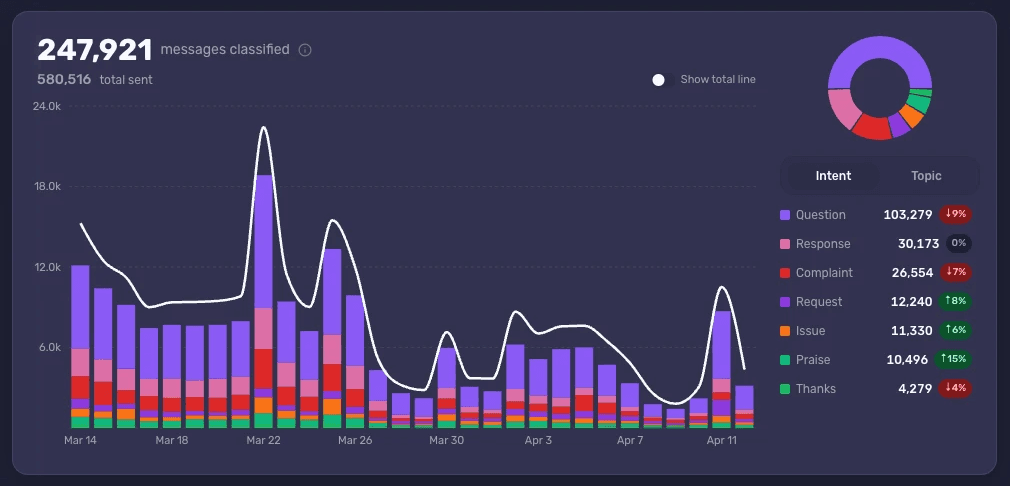
Accord classifies Discord messages natively across the languages gaming communities use — English, German, Russian, Portuguese, Spanish, French, Italian, Korean, Japanese, Polish, Turkish, and more — without translation as an intermediate step. Same intent taxonomy (Complaint, Request, Issue, Praise, Question, Thanks, Response) applied to every message in its native language; same Topic taxonomy unified across the server. The dashboard reads the whole community, not the English slice.
Two implications worth knowing:
Cross-language Topic searches work directly. Filtering on a Topic like "server lag" returns every relevant message across every language. The team doesn't have to know how to phrase the complaint in eight languages to find it.
Language is a Breakdown dimension. Any chart can be split by language to see whether a theme is playing out differently across sub-communities. "Complaints about monetisation, broken down by language" surfaces patterns no English-only read would.
The cheap diagnostic
If your team is running a multilingual game Discord, ask one question this week: "In the last 14 days, what's the dominant Complaint Topic in the non-English channels, and how does its volume compare to the English channels?" If you can answer that in under five minutes, your multilingual read is working. If you can't, you've probably got 20–40% of your community's signal sitting outside the data you're acting on — and the longer the gap stays open, the more expensive the surprise gets when it finally surfaces in retention numbers.
This is one of the underappreciated parts of running a global live-service Discord: most studios think they're reading their community when they're reading one language slice of it. The fix is structural — the right layer, not more hands. The cost of not having it scales with how many languages your community speaks.
See what Accord surfaces in your Discord community — book a demo.